


Buenas, buenas 🐠🧠!
It is February 3rd, 2022, or at least, it was February the 3rd when I started writing this post. The writing took me some months, so I don’t really know what day today actually is. Let’s simply agree your current date is our today.
Just over 150 years ago1, which isn’t that long ago, people were building utopias all over North America. In our digital times most people struggle to get 500 likes on Instagram, but a century ago people managed to get over 5,000 individuals to leave their lives behind and move to promising dreamlands.
Shush, don’t worry. The reason why I’m telling you this will become clear shortly.
Anyhow, so that was then. The words you are currently reading were written on March the 7th, more than a month later. I hate to lie (🤪), and this whole date thing makes me really uncomfortable. Clearly, because I took you to 150 years ago, and now we are here again.. I should have just left it at “it is February 3rd,” but what about all the things that happened between then and now? Surely they count for something? They do, because what happened was this:
Lip mi 🐠🧠, puro lip.
Lectura
Investigación
Procrastinación
In that order. Writing is painful, and I avoid it like the plague, so I wander a lot before I do it. Now, to be fair to me and all the writers out there, that is the meat, the potatoes, el plátano, la yuca, la arepa y el ají de esta vaina. Aquí el que no haga lip no escribe. So that’s what happened, and just so that you know how long it takes to write this thing, just know the last words written in this post are the following: February 10, 20262.
▶ The side story
All newsletters, or at least the good ones, have a side story. It is a little leitmotiv, a secondary topic that emerged after all the research and proved to be very relevant. In the writing, it serves as the overture for the succulent core. Ours is utopias.
Pause. I am grabbing my mate, grab your beverage of choice.
Okay, ahora sí. Acá vamos mi reader fren, mi valiente estandarte, mi pedacito de sol. Tú que me has leído todas mis cosas con un número mucho menor de reniegos y quejas del necesario, tú mi pez amado, tú debes tener sueños, quizás no muchos, pero algunos.3 I know you have some ambitions of your own. Maybe they aren’t enormous, they might go along the lines of “I just want to be a better 🐠🧠, just a 1% better 🐠🧠 each day.” Maybe you want to win a race or be a successful lawyer. Yo que sé, no te conozco bien, no se que es lo que te mueve la aguja. But let’s say you want to do something, to build something. Okay, channel that. Now go crazy, let your imagination run wild! What would you love to do?
Hold that thought for just a second.
Remember Beto, the slow reader? Your colleague! He is also here, next to you, always reading, always a little slow. He was going through the same thought experiment, so you ask him: “what’s your ambition my fren?” Well, here’s Beto’s answer: “my ambitious dream is
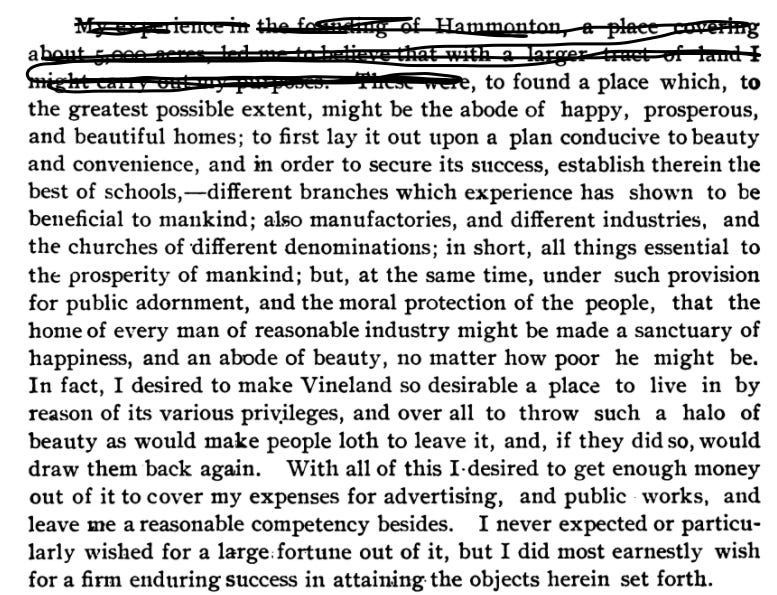
You probably would think: “well, f@#$ck! Beto definitely speaks and writes like a very elegant and old-fashioned North American from the 19th century, and his dream is weirdly specific and well developed, and to be honest much better than my ‘I want to learn how to longboard and cruise like 420doggface207.’” No judgment from me reader, you are an internet kid and I know your life revolves around the likes and the such. Anyhow, Beto’s use of the subjunctive is flawless and that’s hard to find in an English speaker, so you appreciate it and ask him to continue. Beto tells you that he has found land south of Philly that is basically wilderness with great soil ready to be colonized. You cringe, cuidado Beto, esa palabra ahora tiene una carga un poco compleja en estos días. He smiles and goes on.
He tells you he will buy it and found his town there. He will then divide the terrain into smaller properties and sell them. “Wow, Beto la tiene super clara” you think to yourself, and the fact your dream was kind of silly is really coming down hard on you. Well, Beto smells blood so he goes for the kill. He says he will require that buyers build a house on the purchased property within a year of acquisition, that 2+1⁄2 acres (10,000 m2) of the often heavily wooded land be cleared and farmed each year, and that adequate space be placed between houses and roads to allow for the planting of flowers and shade trees along the routes through town. “Damn! That subjunctive again!” Let’s be real reader, at this point you get sour and tell Beto “there is no chance in hell you are making this weirdly specific and anachronistic dream come true!” Beto looks at you with this diabolical grin:
“Oh but I will 🐠🧠, and I will have 5,000 people living in my town in only five years.”
And he wins. Because Beto was just telling the story of how Charles K. Landis founded the town of Vineland, New Jersey, in 1861. Vineland did in fact grow to a population of 5,000 people in its first five years. You can read the whole story as told by Landis himself here, this is also where Beto’s weird scraped page comes from.
Yes, reader, forget about your digital ambitions to reach a hundred likes, Landis actually got 5,000 people to move to his town. He called it Vineland because he wanted to grow grapes, which he did. For that purpose, he heavily advertised to the Italians coming to America during those times. They formed the bulk of the population.
Landis was trying to build a Utopia, he didn’t just want to sell the land and build a town. He wanted to create a society. Landis had principles and values he wanted to instill and foster. One of them was to make Vineland an alcohol-free town. Hush, reader, hush! I know their main product was grapes, but before you let your hippy-raised brain get all judgy and call Landis a puritan and a strict, disciplined man, you have to remember that at that time, the average yearly consumption of alcohol was 7.3 gallons per person. Today’s consumption is 2.1. Back then, the people that drank were drinking all day long4. There were lots of drunks, and that was a problem that naturally created a force against it. Vineland wasn’t the only alcohol-free town, there were several others, and they were all called the Temperance Towns.
Don’t get too hung up on the temperance stuff, that is interesting but way less so than the unexpected outcome of forbidding wine in a town called Vineland whose only product is grapes. I know you, you are smiling and telling Beto: “I told you, you couldn’t pull this off.” Well, my reader fren, in the 19th century all vices used to be replaced with sugar. Alcohol, cocaine, heroin, maturation5, prostitution, you name it, they just threw sugar on the thing. This happened in Vineland too and cascaded into a series of unexpected events.
Ten years after the foundation of Vineland, two dentists, Thomas Bramwell Welch and his son Charlie, figured out a way to pasteurize grape juice so that it wouldn’t ferment. In other words, they invented a way to produce alcohol-free wine that would travel long distances without spoiling. It was full of sugar and therefore delicious. They industrialized grape juice and turned it into an en masse commodity, always sweet, always the same. Marmalades, jellies, baby food, and all the other stuff you use in the typical American breakfast followed the sweetened grape juice. It was a matter of creativity and grit, and they had both. In a few decades, Welch’s became an enormous multinational and a true staple of the commodification of foods.
Wow, your longboard now looks pretty sad! Beto’s utopic dream is huge. What’s more, Vineland wasn’t the only utopia popping up during that time.
▶ Ideals
During every fall in the 1890s, the brothers Gilbert and George Seldes would skip school to pick grapes. Both were short and skinny boys with the grades to afford them to miss a handful of classes. Every week, they would travel a couple of miles to Vineland to sell their crop to Charlie Welch himself. This business brought them $300 a year. At the time this was a solid income and made them affluent people in Alliance, New Jersey, where they lived. The Seldes were free-thinkers and intellectuals. The boy’s father, Sergius Seldes,6, helped founding Alliance as the first Jewish farm settlement in the U.S.
It all started the afternoon of March 1, 1881, when he was 21. That day, word reached Odessa that Czar Alexander II had been assassinated in the morning on his way to the Winter Palace after church. At that moment “Sergius knew, as did his friends and relatives, that the Jews of Russia would be the victims of organized massacres that would start in the small towns and soon threaten the cities.” Their intuitions were absolutely right. Sergius and his friends and family decided to leave it all behind and moved first to Kyiv and then, traveling in small groups, to Hamburg, then to Bohemia, and ultimately the U.S..
Originally, Sergius wanted to end up in Oregon, but the lands in New Jersey needed workers. Places like Vineland were ready to hire hard-working humans, so thanks to the convoluted and inscrutable logic of world history events Sergius, the first of 12 sons to survive (12! 🤯), born in Uman, Russia (present-day Ukraine), ended up a few miles away from the Welch’s as the first librarian of Alliance. Keep in mind, reader, that immigrants that uproot their lives in search of a brighter future are not messing around.
He founded and serviced a post office, cleared land and built houses, planted and cared for grape trees, and instituted the town’s first school. Sergius devoted most of his life to the dream of Alliance. What he wanted was to test, to prototype, to see if he could make an anarchist colony in the U.S. of A. work.
Yup, you read that right, he wanted Anarchy. He believed this was the best way to come to the perfection of the individual. Calma, reader, calma, your hippy upbringing is a true problem for my flow. Breathe in. Get lost in the image below and enjoy it.

Don’t think of Anarchy as chaos and disorder. Quite the opposite, think of it as the honest belief that people can organize themselves and lead their own lives without the need for a government. This idea assumes that people will embrace the complexity of being alive with full force. Anarchists think people will not kill each other over stolen apples, or at least they will do a little less of it compared to what happens in state regimes. Think of them as idealists that believe humans are capable of good and they don’t need a state to thrive.7
Many great minds viewed Anarchy as a viable social structure. To be fair, wouldn’t it be nice if it worked? Did you sign a social contract when you were born? Isn’t the state the rule of the strong few? Isn’t the next step in our evolution to need less of a coercive force? No sería lindo quitarse la idea del estado-nación de encima y simplemente ser un humano habitante de la tierra y poder hacer un viaje por carretera de Bagdad hasta Berlín? Sería lindo viajar sin más fronteras que las impuestas por la materialidad de nuestra existencia y no por la ineficiencia de nuestros sistemas. Sería lindo.
Now that you are calm, let’s move on.
Sergius Seldes “was a libertarian, an idealist, a freethinker, a Deist, a Utopian, a Single Taxer, and a worshipper of Thoreau and Emerson, was also a joiner of all noble causes, and one of them was called Friends of Russian Freedom, of which he was either one of the founders or the secretary.” In other words, he was the ultimate anarchist. Make sure you know this reader, Sergius Seldes was not a simple man. His ideas on Alliance were carefully and regularly discussed and evaluated with Leo Tolstoy and Peter Kropotkin. Alliance was an experiment far bigger than just Seldes, era una esperanza hecha pueblo.
But it didn’t work.
A big reason for it was that the only literate inhabitants of the town were the Seldes, and most of the other inhabitants weren’t there to commit to a particular social structure or to fulfill the anarchic dream. They were there to escape a specific social structure: the tsarist Russia of the 19th century. To be fair, if you were Jewish and Russian most social structures were better than that. But no, anarchy didn’t win. At least not the dreamy version of it.
How things went down is kind of boring, kind of sad, but real, and as I said, we’re here to deal with facts. In a county seat, Sergius demanded that Alliance get new roads and a new school building capable of seating all the kids of the town. If the county didn’t make it happen, Sergius claimed that, in the next election, the votes of the farmers would go to the Democratic Party instead of the Republican Party, who controlled the county at the time. Congressman Wood (Republican) delivered the roads and a two-story schoolhouse, and got the votes in return. That seems okay in principle, right? Power to the people!
But then Congressman Wood realized the process could be made much more efficient by getting rid of the intermediaries! In the next election, he went to Alliance to buy votes in exchange for two $1 bills. The farmers voted Wood and, in return, they got the money. Simple, and much better than having to deal with the fucking school and the logistics of the thing! Politics happened like this for a long time. Sergius tried to convince his town to cooperate instead; he wanted them to pool all the little moneys they had to buy the newest machines the market had to offer so they would not depend on politicians and could be more productive and financially sound. But he failed. The politician deals were more straightforward and secure: they were an eye for an eye. Seldes’ ideas were bets on the future; uncertain, hard to execute. Utopian anarchy lost, democracy won.
Sergius Seldes ended up moving to Philly where he bought an old pharmacy and made it his business. The man who sold it to him guaranteed him it was a profitable business and it would stand on its own two legs for a long time. If it didn’t, he would buy it back at the purchase price. It was a sweet deal. The first day Sergius opened his new business he found a long line of people waiting for him. They were the regulars and all looked homeless. Sounds more like a bar, right? Well, they all wanted either heroin or cocaine, which at the time were sold legally in pharmacies. Nothing is more steady for a business than a subscription model with a very sticky product. Of course the pharmacy was profitable, and of course it would have survived a long time.
Seldes was a good man, he told the junkies to fuck off and stopped selling heroin and cocaine. He could have continued with the pharmacy’s main source of income, but he didn’t. Instead, he turned it into a place for freethinkers to come together and think. Think of it as the cornerstone coffee shop of the 1900’s. And sure thing, thinkers came. It was still a pharmacy too, but with lots of thinking and conversing. From there he ran the Friends of the Russian Federation, from there he talked to the remaining brilliant minds of 19th century Russia. This pharmacy sustained the rest of his life and the early endeavors of his sons.
Sergius died in 1931, the pharmacy didn’t survive him.
So there you have it, two Utopias. One, based on sugar, fully exploded. The other one, the free-thinking optimistic one, imploded. Although perhaps it didn’t. Maybe it just turned into a coffee shop, a more gentle and honorable vice.8 Maybe neither really worked and the power of the globalized world won over both. The only truth is that the electronic dreams of the metaverse kids and the internet are pale and sad in comparison with the small utopias built on sweat, tears, and blood. But maybe I am just being romantic again and I should go back and read my first post. I don’t know. Should we lose all hope here? That’s not for me to decide – do with it whatever you want my dear 🐠🧠, that’s your journey, not mine.

▶ The antihero
The antiheroes of this story are not Charles K. Landis or Sergius Seldes. Those were full-on heroes, they represented the turn of the century for people in the United States that wanted to build a brave new world. I know you reader, at this point you are looking at me funny. You think I am romanticizing the story of the white guys in the North, but you’re wrong. I was educated to thrive on indignation, resentment, and cynicism. How else do you think I earned a Ph.D.? Indignation, resentment, and cynicism are the necessary lenses upon which the academic intellectual stance is built. Most people confuse this stance with critical thinking – it is not – but it is a cheap and easy substitute, and it plays sexy online if you keep it to 140 characters and the right gifs.
No, I am not romanticizing Seldes or Landis. I do admire the grit to physically build a new town with values and ideas, even though those values and ideas might be as wrong as you and I are. And yet reader fren, never forget that the future generations will judge you and me, not on the things we did wrong, but on the things you and I are convinced we did right. Your tiny boogary and ugly 🐠🧠 offspring and my gorgeous son will look at us with a pointed finger telling us how idiotic we were when we thought we were much better than the previous generations.
The first of our antiheroes is George Seldes, the son of Sergius Seldes. Finalamente! Que hijo de puta pa’ hablar eh? Educated by his anarchist father, at the age of 19 he started his career as a journalist for the Pittsburg Leader. His first big assignment was to interview presidential candidate William Jennings Bryan. The angle was that Bryan kept running for presidency yet losing the election. He did that three times in a row. When Seldes went to interview him in his hotel room in Pittsburgh, he asked him what any 19-year-old journalist would ask: “Do you think you are going to lose again?” Apparently, everybody thought he would, but the candidate didn’t like it, understandably. And so he kicked him out of his room and terminated the interview. George Seldes thought he had messed up his first big assignment, but it was not the case. Quite the opposite, it was his most important lesson in journalism, as his editor was ready to point out. “The story is that he kicked you out of the room, write that.”
I ❤️🔥 it. That juxtaposition of events encapsulates the difference between reporting and what most of us inadvertently think is journalism. Reporting is what people do, that is it. It can be boring, cruel, brutal, or pointless. The other thing, the talking, what people say, the theory, what opinions are made of, and what you and I love to believe is journalism, that is just narrative. It is cute, but it’s not honest, it is just mental gesticulation. The young grape-picker internalized this first lesson deeply in his mind.
From then on George’s career was prolific and extensive. First, he went to France during World War I as a member of the press corps of the American Expeditionary Forces reporting for the United Press. Just one week after the end of the war, he interviewed Paul von Hindenburg, the supreme commander of the German Army. Hindenburg supposedly acknowledged the instrumental role the U.S. had played in defeating Germany. “The American infantry,” said Hindenburg, according to Seldes, “won the World War in battle in the Argonne.” The interview was never published in any newspaper or magazine of the time. Seldes and his colleagues had broken the armistice when they entered Germany after the end of the war. They knew they were guilty of that, but they thought the importance of the information would help the publication. It didn’t. Until his death Seldes believed that blocking the publication had helped fortify the back in the stab myth that lead the Nazis to power later on.
After WWI, Seldes started working for the Chicago Tribune. He was immediately sent to Russia with the objective of reporting on the Bolshevik revolution. The Soviet change of regime had produced a catastrophic famine in Russia (present-day Ukraine).9 The U.S. offered to provide a massive relief package with the condition that journalists were allowed to report on how things were going. Seldes was basically part of the package.
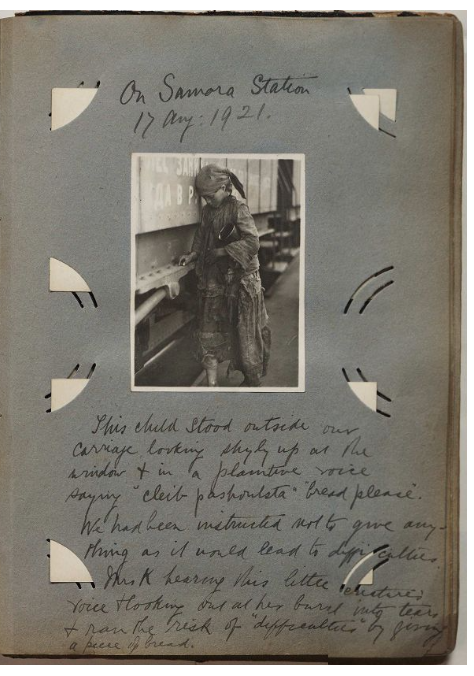
Just as he had done in Germany, Seldes got to interview the most prominent player of the conflict, Vladimir Ilyich Ulyanov better known as Lenin. This time though he didn’t have hours to sit with his subject. It was in 1922 during the fifth anniversary of the revolution. He together with all the other American journalists were shoved in a room and were allowed only one question. The first question asked was silly and understandable. It came from a young boy with an enormous hat that was trying to make him look older. It only made him look even younger. “Do you speak English?” Answering in poor English, Lenin noted, “I can not understand you, Americans especially, because you hate the word bolshevism—so you make bolshevism the most hated word. After all, there are many interpretations of Karl Marx and bolshevism is one of them.... [W]e adopted the one that Daniel DeLeon started in the Socialist Labor Party.” To which Seldes cried out, “That’s my father’s friend you’re talking about!”10
Yeah reader, picture that. In a room full of journalists, Lenin declares the importance of the leader of the Socialist Labor Party of America in the creation of the Soviet Union. Then comes this young dude with a mustache that frankly could use some oomph and class and declares, “that’s my father’s friend!” If you hadn’t read the previous paragraphs you would think, “what a douche-bag, who cares!?” We do 🐠🧠, we do! Because we know the story, and we know who Sergius Seldes was and we can imagine him having coffee and debating ideas with De Leon in Phili.
And now Seldes had Lenin in front of him talking about one of his father’s friends while producing a famine that accounted for 5-million-dead in the country in the name of a greater future.
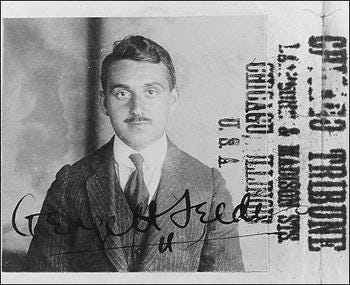
It didn’t take too long for Seldes to be deported from Moscow. The Soviet censorship was tough and, as you can gather, there was a lot to denounce. Each letter that left the country was carefully scrutinized, so reporting on anything of importance wasn’t easy. But of course the journalists, Seldes included, found a way to circumvent the censors. It was the same way all drugs are smuggled: the diplomatic way. The bureaucrats in charge of all things Soviet would use the official diplomatic channels to exchange forbidden goods for Russian delicacies. Basically, they would exchange mink coats from the Tsarist times for fancy chocolates and other food items — remember the famine. Therefore, these diplomatic channels were intentionally left alone by the censors. The journalists could then disguise their articles as personal letters and send them as diplomatic mail.
But then the idiot showed up! What idiot you ask? The idiot that always shows up and ruins the party. This one, in particular, denounced a comrade that was smuggling cigarettes from the west, and so censors got involved and had to get all serious about the thing and started reading the letters. As a consequence, the journalists were caught and got kicked out. До свидания, мистер Селдес!
What do you do after you get deported from the Soviet Union? Go to Italy of course. That is always a good response to anything that happens in life. Seldes went to report on Mussolini and the ascent of fascism. Here he denounced the participation of Signor Benito Mussolini, Il Duce, in the assassination of the socialist leader Giacomo Matteotti. The case was a convoluted one, and it is still debated today. Although if you ask me, the evidence on what happened is pretty clear. If you ask Seldes, there was no way to be confused, Mussolini was involved either by commission or omission. As you can expect, Il Duce didn’t like this at all and Seldes was also kicked out of Italy.
Then he was sent to Mexico. Here our grape-picker tried to denounce the interference of American corporations in Mexican politics and legislation on mineral rights to their own benefit. He was denouncing the way American corporations were and have lived and thrived in Latin America. Ay mi 🐠🧠 acá podríamos quedarnos horas hablando de las bananeras, de los trenes atravesando las plantaciones y los colores incandescentes del Caribe, pero esa no fue la ruta que tomó Seldes y por lo tanto tampoco nosotros.
As you can imagine Seldes was kicked out of Mexico too.
The list goes on and on in similar fashion. At this point Seldes started feeling as much backlash from the European and Latin American governments he was denouncing as from the internal powers in the U.S. It was to be expected. Seldes did not give a single fuck, he was in this world to report the doings of the peoples in power and the doings were pretty much always nasty. As the years passed by, his relationship with the owner of the Chicago Tribune deteriorated, and less and less of his work was published.
Finally he quit and published two books with his unpublished stories of the time. Both books are history lessons. Both are very, very hard to fact check, although all of my efforts tend to prove Seldes right. Both books live here on the Internet free and open for you to read my dear 🐠🧠.11
From then on George Seldes became an independent journalist. His career went on. He denounced the Tobacco Industry and the negative effects of cigarettes on health, the arms industry and how it profited from 40 years of war, Franco’s darkest moves in the Spanish Civil War, and the quiet complacency of the American Press, among all the atrocities the 20th century produced.
It is hard to get a grasp of the power of this work if you don’t do the homework 🐠🧠. But I’ll save you the hours of reading and fact-checking that trusting Seldes requires, I did it for you. However, I do suggest you watch this documentary about him — we all know you are more on the side of TV than books. But just to get an idea of what he was against and what he was bringing to the table, do the following: take a minute and read this page of Time magazine:
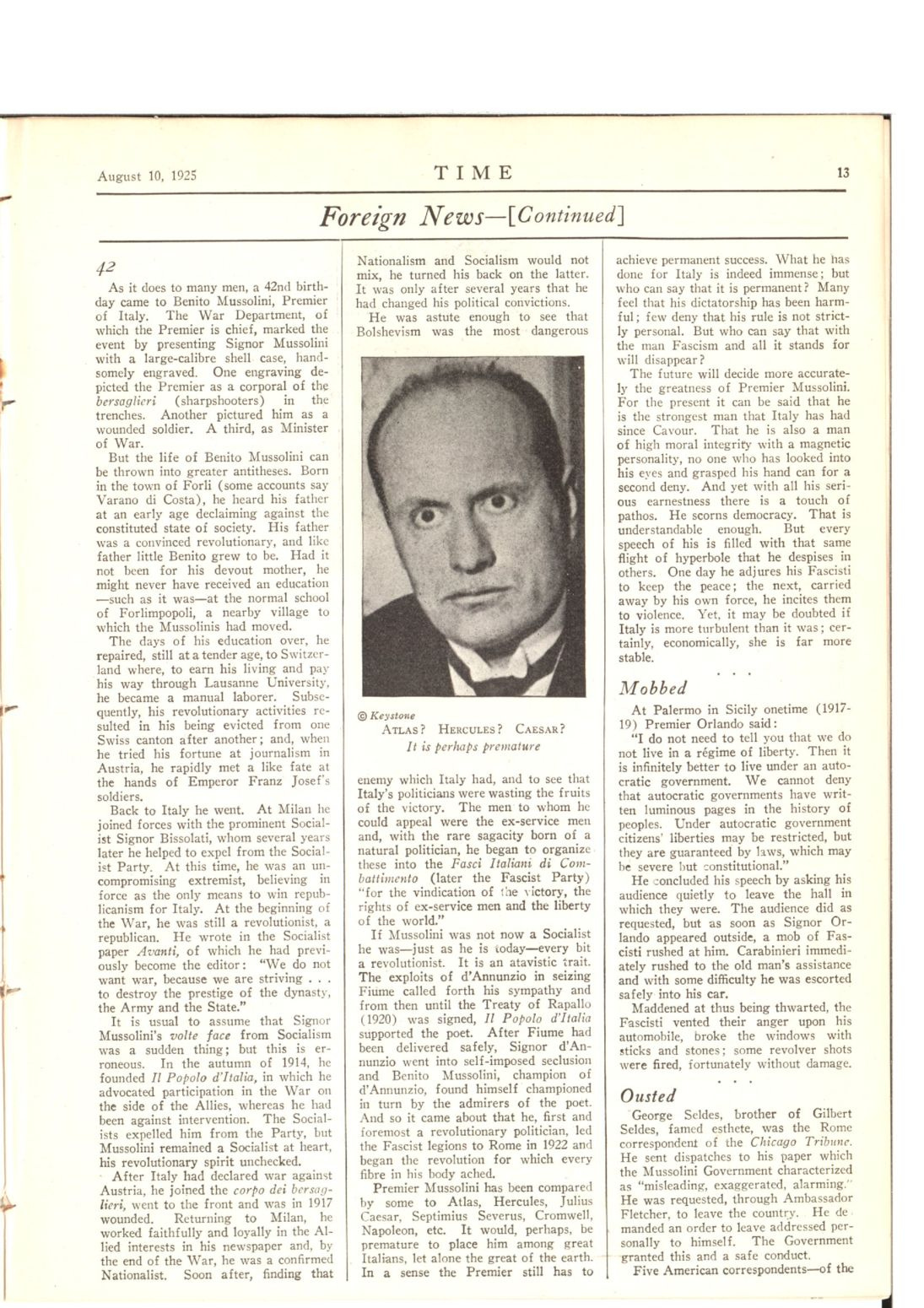
I ❤️🔥 it. That juxtaposition of events encapsulates the difference between what most of us inadvertently think is journalism and what reporting is12. I really want to go over their description of Mussolini, I want to 💩 on their comparison to Hercules and Cavour, and I want to go over the idiocy of leaving it up to time to decide the greatness of the Premier as they call it. But I won’t, because that’s not the point. The point is that the article on the next page declares how Seldes was kicked out of Italy because of his denouncement of Mussolini, but that part is left out. That part is not worth telling. Mussolini’s story is all color and fanfare, it is literary oomph although no class. Seldes’ story has no color, no rationalizing, just the hard facts – unfortunately not all the facts, just some of the facts.
And that my dear reader fren was what Seldes was against. That was the system. He was tired of fighting from within. So he decided to change the medium. Which brings us to the peanunt of this whole post.
▶ The financing
Listen, reader, let me shed some light on that beautiful brain of yours. I’ll cut the crap. When most of us — fish brains that we are — think about a medium, we confuse the medium with its content. Consider the car. We think of the car, the machine, as a medium of transportation. Yet that’s inaccurate; what allows the car to go round and round are the roads, the gas stations, the legislation, the car industry, and so on. The cars are the content, the medium is what allows it to be. The same applies to all the media out there; to our new digital paradigm the internet, and to the old print one the printing press.

Seldes was painfully aware of this. He knew the main customers of newspapers weren’t the readers, but the advertisers. And he knew this would only get worse in his lifetime. He also knew that apart from the commercial pressures, there were the political and legal ones from the legislators and bureaucrats, as well as the biases and personal agendas of the owners of the newspapers. He wrote for the readers, but the system didn’t work for them. You now know why 🐠🧠, remember medium ≠ its content. If you consider the newspapers as a medium, then you can see they are a product and reflection of the technologies that allow them to exist, not the articles of the intrepid journalists. They must abide by the architecture of those technologies and not by the desires of the peasants (i.e. the writers and the readers).
Check the following graph:
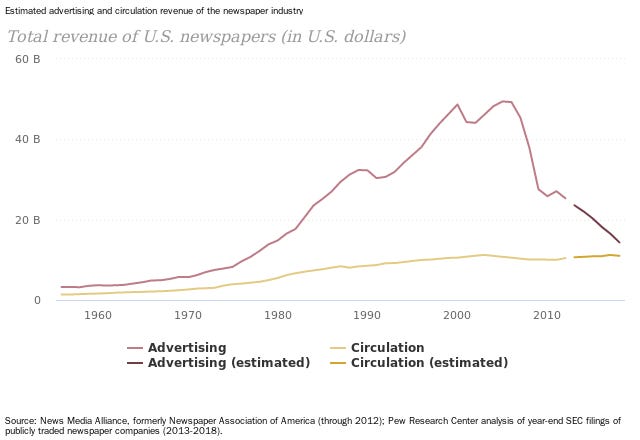
The yellow line is the money that the publishers get from selling papers to the public and the red one is the money they get from advertisers. You can read this graph in so many ways, you can adjust to inflation, and you can see what the petrodollar system did to the news business in the 70s, you can discuss the weirdness of the 80s, but none of that matters. The point is that Seldes was right and the percentage of revenue that came from advertisers only increased during the 20th century, that is, until … the internet boom.
Then the curve started changing and the reader became the main customer. You might think that was a good thing, but that’s because you are silly. Sergius would scold you. First look at reality, look at what is happening right meow! Are you better informed now that the media tries to satisfy the views of the people and not that of the advertisers? Weren’t you complaining only three days ago about how much tribalism and polarization is out there? Do you find that getting reliable information is easier nowadays?13
All I can say is that now we have a new system with new problems. The new architecture demands more from the reader than the previous one. That’s good if you are willing to do the work and learn, and it’s bad if you just want to sit and watch the news while you eat your dinner. It all depends.
Seldes understood the architecture he was working with and said something along the lines of: “well my friends, I am tired of this b.s., no more newspapers, I am doing my own newsletter with no advertisement whatsoever. All I need is my articles, a photocopier, and enough readers willing to pay for a subscription.” Yeah, he was somewhat ahead of his time. He had the connections, the expertise, and the guts. He started it in 1940, and he made it work for the next 10 years.
In Fact was a 4-page news sheet written almost entirely by Seldes, and it sold for two cents. Seldes attacked newspapers that took ad money from tobacco companies and failed to report on the health risks of cigarettes. He went after strike-breakers. He reported on the FBI’s surveillance of unions (and drew FBI attention of his own). At its peak, 176,000 people were reading In Fact—including Eleanor Roosevelt, Harry Truman, and “approximately 20 senators,” according to The Washington Post. (Wired)
Let me clarify something. Seldes wasn’t really using a photocopier. He was using a mimeograph. You can think of it as a tiny printing press, as minimized and optimized as that technology could get before introducing the optical element of photocopiers. In the 1940’s you could get one for the equivalent of $1,000 in present-day money, which wasn’t bad at all if you consider you could easily produce thousands of copies of your paper at a very, very low cost.
This is crucial my 🐠🧠, because it shows you that technological changes allow you to say different things. They change the quality of the knowledge we produce. Is not that we know more, is that we know different. Without the mimeograph we wouldn’t have content like newsletters and the control of the public sphere would still be in the hands of the gatekeepers. Shush, shush, reader, sin cinismo, que claro que por supuesto que los cambios tecnológicos sólo implican cambios en quiénes tienen el control. And yet, denying the deflationary power of technology and its amplifying possibilities would be silly.
After a life of fighting the powers that be with words and trying to change the system from within, Seldes managed to build a platform that amplified his own voice. It might not have been the utopian dream his father had in mind, but it was as close as you could get to living those ideals in the Public Opinion Sphere.
And that brings us back to February 24th, 1941.
▶ The unspeakable
Remember how I started writing this post in February 2022, well now it’s May and I am still on it. You thought reading it was hard work, huh? Back then I wanted to find a newsletter from the same day I was writing. I was delighted with the idea of finding an old newsletter from the 1700s that I could use as an excuse to talk about the history of the newsletter. I simply wanted to have a straightforward lip without the ups and downs, the going around,14 the coming back, and all the labyrinthic nodes you are now used to. But reality doesn’t follow the rules of my brain, it is not linear and it doesn’t care about what makes sense or what doesn’t. And it gets worse.
Not only do I have to deal with the chaotic structure of reality but on top of that, all I get from the past is the incomplete and capricious nature of what we are actually able to preserve in digital or physical form. So that’s how I ended up with the issue of February 24th, 1941 of InFact, Seldes story, and all the rest.
Sure, that issue wasn’t what I was initially looking for, but it was brutally and soul-crushingly better. It had it all. Getting the alternative take on what the public opinion was during World War II in the U.S. is mind-blowing. You readily find that there was no clarity at all. The presence of a marked enemy does not provide unity and a common objective. It creates more division. It fosters a plethora of half-baked ideas easily grouped into two polar opposites and a full lack of understanding of what is going on. Yet that is not what blows my mind. Just looking at the present you could deduce that something similar – division and no clarity – is what is going on. What blows my mind is how easily we forget that, how easily we think that there was more certainty in our past. We project how we understand the past to the reality of it, and we falsify it. We know this, and yet we do it over and over again.
Yeah, that blew my mind. And then this caught my attention:
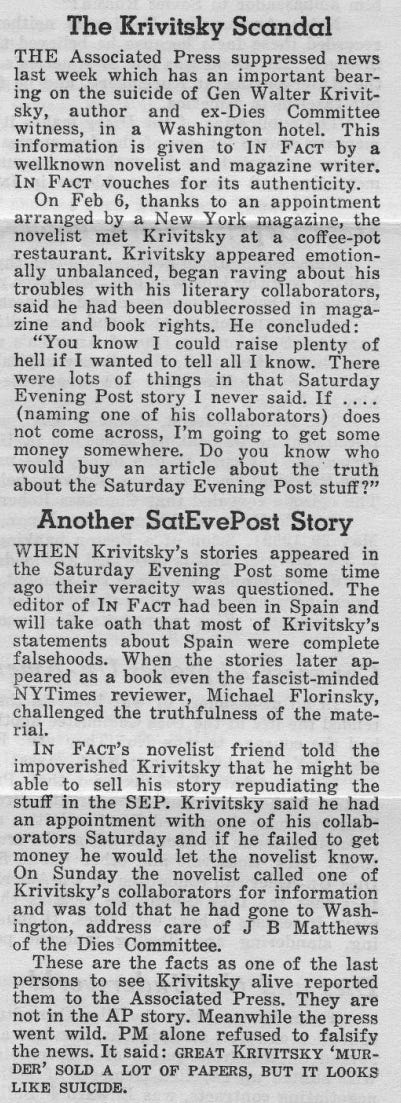
Walter Krivitsky’s real name was Samuel Ginsberg and he was of Jewish descent. He was born in Podwołoczyska, Galicia, Austria-Hungary (now Pidvolochysk, Ukraine) in 1899. Podwołoczyska was a tiny town of wood houses and dirt roads. When Ginsberg was growing up it was right on the border between the Austro-Hungarian and the Russian Empires. It was a crossroads of people and cultures. Poles, Ukrainians, Austrians, Russians, and all the possible combinations between them made up the ethnic soup of this town. Oh yes! Samuel was Jewish too, which added all the complexity this entails in a soup of Christian denominations.
To make things more fun, smugglers and political exiles tried trespassing the border by mixing with the natives and catching trains for unknown destinations. This meant that the town was under close watch and there always existed the lurking possibility of an occasional police crackdown from Lviv (then called Lemberg), the administrative center of the Ternopil provinces. “The wide-gauge tracks of the Russian railroad system ensured that no train could proceed straight from Europe into Russia, or the reverse, so all travelers had to change at the border.”15.
Remember how Sergius Seldes left Russia (now Ukraine) right after the assassination of Czar Alexander II, fearful of what would happen to Jews afterwards? Well, Samuel’s parents didn’t leave. They stayed and saw every drop of antisemitism that this region of the world, in that time of history, had to produce. They saw antisemitism from the Poles, from the Hapsburgs, from the Russians, from the Austrians, and from the Ukrainians. Which explains why Samuel learned Polish, German, Russian, and Yiddish. It also explains why he developed all the skills needed to become a superb subvert agent of the Soviet Union. He had been escaping from everybody all his life, he knew how to hide, how to disguise, how to confuse – he was the perfect spy. In 1917, when he graduated from High School, he was ready:
“I joined the Bolshevik Party with my whole soul. I seized the Marxist and Leninist faith as a weapon with which to assault the wrongs against which I had instinctively rebelled.”
“Krivitsky was an ascetic and workaholic, allowing himself no luxuries, never drinking, and remaining on the job 16–18 hours a day. Nicotine was his only drug. The general rule was ten in the morning to midnight nonstop.” (A Death in Washington)
For twenty years he went up the ranks. When you have been wronged by all nationalities you lose respect for all nations. Your task is simple: take over the whole world, and create your own nation. He organized industrial sabotage and worker strikes in Germany. He stole the blueprints for submarines and planes in Italy and France. He was instrumental in the interception of correspondence between the Nazis and Imperial Japan, which was the first time the world knew about the allegiance. He recruited Magda Lupescu, the third and last wife of King Carol II16 of Romania, as a spy. He recruited French politician Pierre Cot. He was every writer’s spy dream.
His list of accolades goes on and on. Because of them, he was proposed as a recipient of the order of Lenin, one of the highest ranks in the Soviet Union. He never got it. By then, Stalin had started killing all Trotskyists and Leninists, and those were the signatures needed for the award.
In May 1937, Krivitsky was sent to The Hague, Netherlands, to operate as the rezident spy (regional control officer) in that part of Europe. As if written by Borges, he worked undercover as Dr. Martin Lesser, an Austrian antiquarian and refugee from Hitler’s antisemitic persecutions. Specialty? Old art books. This cover was brilliant; it allowed him to speculate and launder any money needed, but also to send documents in the binding of old precious books. He rented and lived at 32 Celebesstraat. The landlord was Hendrik Krop, a tax inspector and also a communist, which was very handy. Krop’s brother, Hildo Krop, was Amsterdam’s most prolific sculptor at the time and also a communist. Also super handy and not a coincidence.
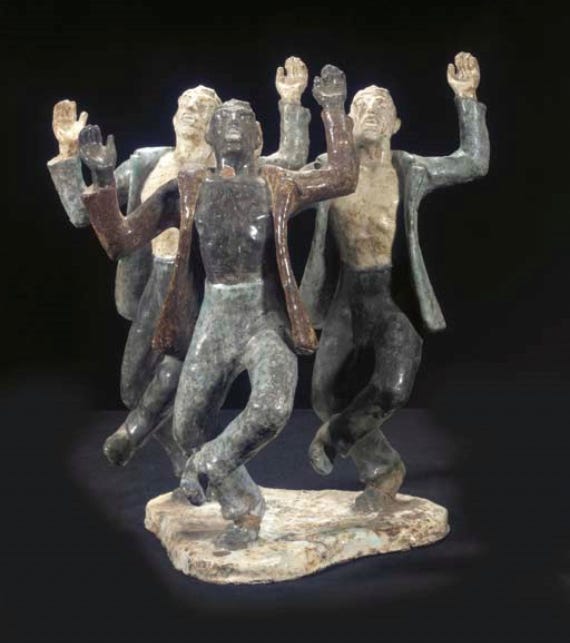
The revolution is a family affair, it is done by friends and family that have been wronged awfully by some other asshole cousin. Hildo was a soviet agent recruited years before by Ignace Reiss. Reiss went by the alias of Ludvik, and was a mythical spy in spy literature. When Walter arrived in La Hague, Ludvik was stationed there too. Here’s when we come full circle: Reiss was a childhood friend of Kirivitsky. He also was born and grew up in Podwołoczyska. He was jewish too, and had also seen his fair dose of antisemitism and oppression. Just like Samuel, he joined the Russian revolution with the Bolsheviks. He too had all the skills necessary to become a world-class spy. He also had been wronged all his life, and he too, through his resentment, wanted to build a greater future.
And so he did.
Reiss and Kirvitisky had coincided in their careers here and there but now, in La Hague, they were in the same playground in a more definitive context. Imagine that, it was a dream come true. After twenty years of shared oppression and discrimination, and another twenty years of spy work all over Europe, the two friends from that little crossroads town right on the border of neighboring empires end up together. They both have covers that contemporary writers dream of, they both are giving the middle finger to the world’s establishment, and they both feel and know that they are changing history. Justice is being made!
Yeah…
The thing is, when you are in charge of a global revolution, you are a man with a mustache and you truly believe you are right and moral, and your ego is so big that you can do the unspeakable. Stalin was in that situation and decided that all the Lennistits and Trotskyites were an obstacle to the revolution, so decided to kill them all. The cause justified it. Reiss and Krivitsky saw it coming. They knew a global revolution wasn’t just going to happen with nice words and Borgean covers; blood needed to be shed. They had been playing the game since they were seventeen, and so they kept playing. They played under Lenin rules, and now they would play under Stalin’s. They joined the purge, at least for some time.
Qué problema en el que me metí aquí 🐠🧠. Quería analizar eso de “playing the game” e introducir lo que venía después en la historia de Krivitsky con un párrafo bien sesudo. Lo primero que escribí fue esto: “el que a hierro mata, a hierro termina.” Here, I wanted to point to the cultural differences between English and Spanish. The English version goes: “He who lives by the sword will die by the sword.” This difference would allow me to ponder about the insistence of the Spanish language to use the material: hierro, plomo, plata as a metaphor of the thing, versus the English language’s need to go with the tool: sword, bullet, coin. I was going to follow it up with a nice reflection on how all books of any value say it all. Everything that can be said about the human being, everything that can be expressed in our language is in the Bible, the Koran and Whitman’s poems. And then reality hit my soul with all its harshness.
The world is full of retired assassins who enjoy a good mate on a deserted beach.
I’m putting it this way, with the mate and everything, so you understand how much it hurts. Don’t forget that they killed my uncle with a tiro de gracia—an execution shot—on a highway in the middle of nowhere, where everything is green and the blue of the sky burns your eyes. That damn cursed land that I love from afar. Right there, just like that, in the name of the revolution and in the name of a better world. Someone made a statistical calculation, an investment: I’ll kill you now for a better future. Like someone killing a fly that’s about to ruin their afternoon.17

I wish reality played by the rules of fiction and satisfied the literary aesthetics of our souls. But it doesn’t. There are retired nazis living peacefully somewhere in South America, there are retired Soviets watching spy stories on Netflix from the comfort of their couches. There are drunk American soldiers that came back from Afghanistan broken and broke. Those are shooting meth in some dirt ass trailer in Arizona, while the politicians that sent them to fight get drunk in Washington cocktails parties. I am not saying their crimes are equal, and I am also not equating those in power, the Stalins and the Lenins, the generals and the presidents.
I don’t know their reasons or their circumstances, but I know this: a bullet is not coming for them. Nor should it. Some of them will die happy and fat, with no remorse and lots of pride. Life will not give them back what you or I think they deserve. They will just be, like you or me. Even if it hurts, they will just be in you and in me. We all share the same root, and the same destiny.18
So let me get back to my borgean story because in this case, it does follow the rules of literary stories and that will bring your heart to a better place. Reiss and Krivitsky played the game for a while. Until it got too close to them. They were Bolsheviks after all, and very few of those were still alive.
When Reiss thought he was next, he deflected, and he did so loudly. He wrote a public letter to Stalin, in which he denounced what he had witnessed and he made a call back to the roots of the revolution.
I have been fighting for socialism since I was twenty. On the threshold of my forties, I don’t want to live off favors from a Yezhov.
I have sixteen years of underground work behind me. It’s something, but I still have enough strength to start all over again. Because it is a question of "starting all over again", of saving socialism. The struggle began a long time ago. I want to resume my place there.
Coming from one of the most successful spies of the revolution the words were meaningful. In present-day corporate lingo, people would say: “the optics were not good.” In Bogotá in 1996 we would say: “qué mierdero.” Stalin responded with fifteen shots. Seven went into Reiss’s body, five went into his head. The letter was dated July 17th, he was assassinated on September 3rd, 1937.19
Reiss’s death was enough for Krivitsky. After all, he knew he was next. He fled to the U.S. the first chance he had. His wife and kid followed. The first thing he did was to disclose some of what he knew. Make himself visible and known. He published a series of articles in the Saturday Evening Post. These were the basis of his book: In Stalin's Secret Service. The book had an underwhelming reception. Most people didn’t want to believe a deflector and lots of people still wanted to believe in the revolutionary dreams of the Soviet Union and their revindication of the working class. They weren’t ready to accept the cost Stalin was willing to pay for those dreams.
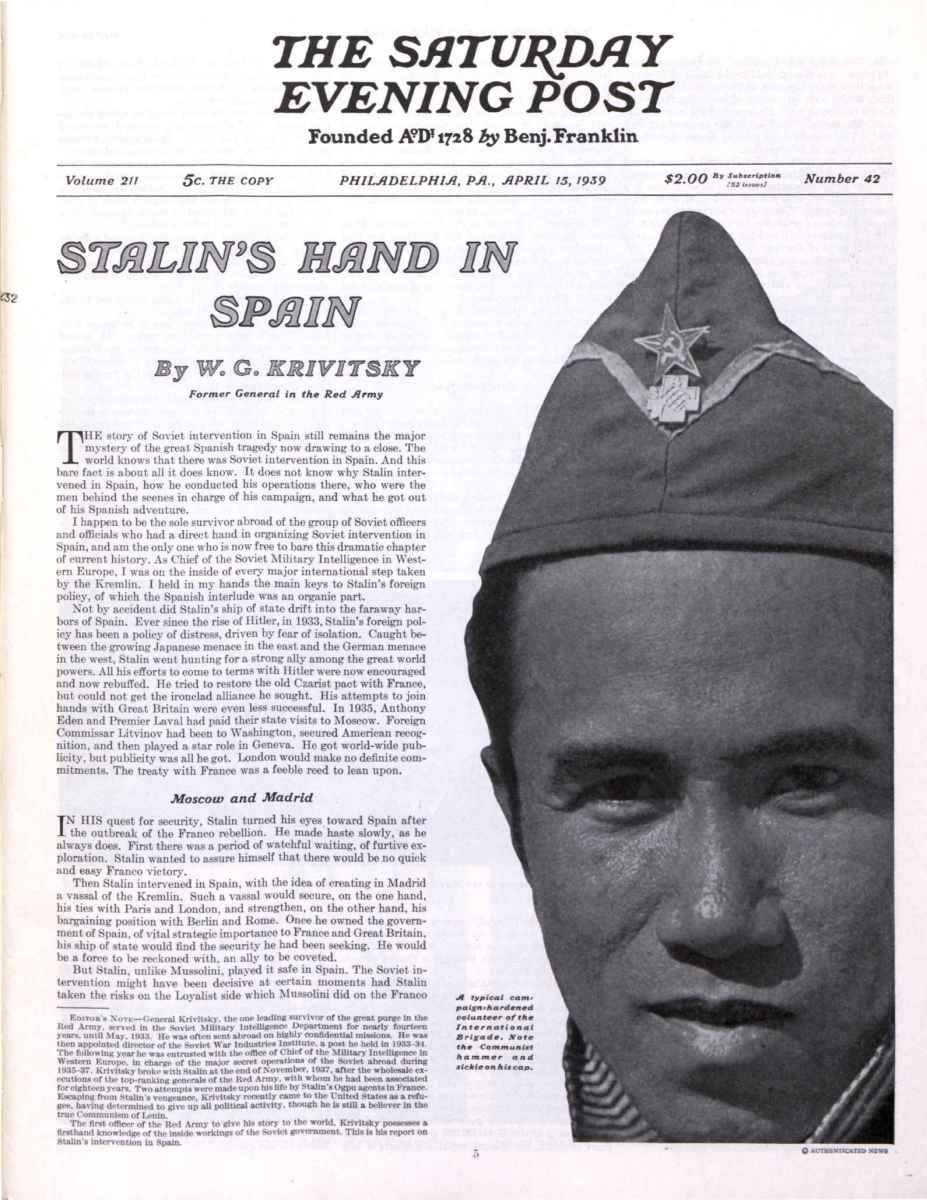
Yet Krivitsky was ready to show the world how Stalin was not the revolution. He was ready to show the world how Stalin played the game. That included denouncing the German-Soviet Nonaggression Pact, i.e. how Stalin and Hitler helped each other for a couple of years. That was way too much for many people to handle. Weren’t the Nazis anti-communism, weren’t Mussolini and Franco killing commies with the aid of Hitler? Wasn’t Stalin the biggest of the commies? Yes, they were, but sometimes blood needs to be shed and sometimes a pact with the enemy has to be signed. It is all part of the calculations we do for a greater future. A matter of investment policy. Sometimes you need to kill some flies in order to have nicer afternoons.
Life was alright for Krivitsky while in the U.S.. He collaborated with the British Government, which led to some of the loudest scandals of the time, he gave some info to Americans, and he lived off the proceeds of his book. Walter was smart though and dosed the information he was willing to share. He needed ammo to bargain while he worked to settle on a farm in Virginia, which was his goal. Like you and me, he knew what was coming for him. He knew the Soviets were after him. He said to friends and family: “if I die, you know who did it.”20
And death came. It used a gun in a hotel room in Washington D.C.. It was a small hotel, unusual for Krivitsky. Un tiro de gracia en la sien. He left three letters, all hand-written. The content of the letters survived, and photographs of the letters survived but not the letters themselves. The case is full of details and nuances but we won’t go there. I will summarize it this way, we have two confirmed testimonies from Krivitsky:
in one he said if he dies, to blame the Soviets, and that this will most likely be his outcome.
the other is a suicide note that said not to blame the Soviets.
That is it. That is the conundrum. Which one do you believe?
Well, Seldes chose to believe the suicide theory. He thought the press was being sensationalistic with a story that was closed and declared a suicide by the authorities. Ignace Reiss’ wife believed the same thing. And yet plenty of Krivitsky’s “colleagues” did not buy it, they knew it was a soviet crime. The press certainly thought there was something fishy. The evidence is full of holes and uncertainties, so all stories have problems.
You ask me what I think, reader? I think it’s only relevant to know the author of the letters for literary reasons. To complete the story, to have a nice narrative. But I don’t want to do literary math. I don’t want to choose between narratives. I take the bullet as the tragedy it is. I think of the moment when a human performing a simple statistical analysis decides that pulling the trigger is the best choice for a greater future. Whether that future is nothingness or a communist dream is irrelevant to me. Not because they are the same, they are not, but the humanness behind both is the same.
I look at that moment, look at my child, and I feel cold tingling beneath my skin. I feel it and I try to empathize with the human with the gun and this is what comes to my head: I remember a childish lie I told when I was sixteen years old. It was big, grandiose, and it made me both a victim and a hero. I chose that lie. I chose to live it. You most likely did the same thing 🐠🧠. And like me, you quickly realized only more lies can sustain a lie. The truth will kill it, and killing it is killing yourself. So we don’t speak of it; we let it grow, we don’t confront it and it becomes a monster. By this point, there are a lot more people involved in it. At that point, the lie also sustains other parts of your life. Not directly, but just because it is part of you, it is a part of your soul. And you will defend yourself at any cost. Any cost but the truth, because the truth will kill you. Here’s the thing: I don’t know if this is true or not, but it sure does look like this to me. At one point you end up cornered, and a bullet finds its way to your head. And it either kills you physically or metaphorically. And that is it, that is life: the things we cannot speak of.
▶ The truth
If you were more than a 🐠🧠, you would have noticed that the issue of InFact I brought to you was from February the 24th, 1941. On exactly the same date in 2022, as I was writing this post, Russia invaded Ukraine — once again. That day the fear of a global conflict of nuclear dimensions hit us all in the gut, just when we thought we were done with global conflict. It was The Return of the Proxy Wars — a beautiful and cynic title for my next poetry project.
No, reader, I am not manipulating you or the plotline of this post. I did not choose InFact after the start of the war, I did not go and look for it so that I could talk about the current events. The numeric parallelism only opens enormous and uncomfortable questions. Why are we still here? Why are we doing the same thing we have done in the past? Can we collectively learn or are we doomed to our own stupidity? Is the accumulation of simplistic statistical decisions in the name of a greater future what brings us here? Is it the need to sustain the lies we tell ourselves when we are sixteen? Is it both?
Those are gargantuan questions.
Here are my answers, incomplete, biased and unnecessary, yet deeply satisfying. Seldes and Krivitsky’s stories shed some light, and understanding them helps me accept reality, as crude and brutal as it is.
I understand how Seldes’s father went one way. I understand how Trotsky, and then Stalin, went another. I understand why Landis wanted an alcohol-free town and I understand why Welch created an emporium of epic proportions based on sugar. I can tell you that I have anarchic dreams, and I do hope that technology can help us organize society differently. I do fear for my son, and I don’t want him to live the lies and the truths I had to live to be here. I don’t want him feeling the visceral fear you feel when there is a man with hatred in his heart, a mustache with no oomph and class, and a gun in his hand standing in front of you. And yet there is nothing I can do to avoid that.
I believe this is also what Sergius Seldes felt, as much as what Krivitsky thought about his own son. I believe that even though I share no tangible experience with them, I do share that inner primal fear, the lies, and the heart; in other words, the humanity. I know too that I have the potential in me, like you and my son, to do all the atrocities Seldes, Krivitsky, Reiss, Stalin, and Lenin produced. Because we all share that thing called life in us.
And here’s one more thing:
“When they discovered I could speak German, Russian, Polish and French, they smiled and sent me straight to the OSS – US military intelligence. It was a hotbed of ex-communists and ex-Trotskyists, run mainly by ex-Austrian communists, all of them dissidents. They only wanted to hire confirmed anti-fascists. It was a very sympathetic outfit in those days. I appreciated the paradox. My father had started the century with Soviet intelligence, and here, in the middle of this same century, I was now a wartime agent for the United States.”
Those are Roman Bernaut’s words. He is Ignace Reiss’ son. He went to Columbia University to study economics and then ended up helping the American Intelligence against the Soviet Union. On the other hand, Krivitsky’s son died of a stroke in his 30s, poor and sick in New York City.
That is the crushing whimsical nature of life. Reiss’s son and Krivitsky’s son branch out like an imperfect Fractal Canopy: two possibilities of what could have been. Just as much as Reiss’ and Krivitsky’s deaths are variations of the same theme. They are all the bifurcations and lips of our cruel playwright. They are the random others we could have been, under different circumstances, growing up with different stories. Whether it’s a Western utopia or a communist dream, all leaders believe they are right.
The coincidence of where this post took me, and our current present is not due to random luck. We are still here doing the same things. And we will continue to do so. Performing simple statistical decisions in search of a greater future is what pushes us forward, the narrative we believe unites us as a species is bigger than our individual souls. You might not like to accept it, but you could understand what Putin or Stalin do and did in all its atrocious monstrosity. What’s more you could do the same things based on the same futile reasons.
Todos estamos matando moscas que nos aruinan la tarde. You chose the methods, which flies and the afternoons, and you hope you are not a monster and your values are on point. That is the best you or I can do. Each and every one of our choices is a statistical calculation in search of a better future. The rest is silence.
That is it, that is all I will give you. If you need more than that, just check out The George Hotel, in Washington D.C.. This is where Krivitsky died. Go there, rent a room, and do with it whatever you want. Read the F.B.I. files while you are there and try to figure this thing out. If you can solve the conundrum and get out of the hole I put you in, write me an email, and take us both out of here.

let’s go back to the newsletter thing to give this thing some kind of closure. You now have the rules of the genre and a great example of an issue – if I do say so myself. There is only one good question left. Why did I choose the newsletter as a genre? Because just like Seldes, in this format, I can give you more questions than answers. I can make your head spin knowing that there is something there that you are not quite getting. I can tell you that the truth is a question and not an answer. You can disagree, pout, and shout. And yet I don’t have to justify myself to anybody.
In this format, I can give you my most honest take, the rawest of my thoughts, while staying true to two things: 1) the facts, 2) that you have an awesome time 🐠🧠. After all, as you can see, I am always thinking about you, not the advertisers, nor the owners, nor the people in charge. And yes! I know, I am still subject to the architecture of this medium, and there are still people in charge here. I am not näive reader, this is just how I choose to play the game.
Postscript
Next time you drink a coffee take a moment of silence for Krivitsky’s suicide letters, wherever they are. Also, think about that moment when the cleaner of Sergius Seldes’s house took his correspondence with Tolstoy and used it as kindling to start a fire to warm some water. I love paper, and I still look at my past as an archivist with romanticism in my eyes. I do feel a deep sadness when I think about all the letters that we will never see. It is silly, I know, but there it is. And then after the sadness, the researcher in me makes me think, where is the fragility of the digital medium? Of course, there is a lot that we can see now, but I wonder about the ones you can only see when the next medium arrives. Will this newsletter be burnt and forgotten, or will it be one node of the future lips of a better and more capable writer?
Bueno, bueno, 150 es un error. Digamos que si tú mi fishy fren estás leyendo esto en el 2030, en vez de 150 debería decir 158. Y sí estás leyendo esto en el 2050, debería decir 170. Y ya cada vez que nos acerquemos a 200, la cosa deja de ser poca cosa. Así que te dejo a ti el cálculo de cuánto tiempo ha pasado en realidad.
Let me make a disclaimer. Most newsletters aim to be ultra-relevant, they write of ongoing events. They are on the *it* thing of the moment. I try too. But I am not that cool, is just that between the *it* thing, and the time my thoughts are somewhat formed, a lot of time has passed. And then there’s the writing, which takes forever, and then editing, publishing, and all the things. Quality takes time.
Yes, I got real mushy and corny there. The purpose is twofold, to bring out your cynicism and to put you on my side. I am going to ask you to do something, and that’s not an easy task, so I am anticipating some resistance.
Check out this fantastic free e-book: https://books.apple.com/us/book/spirited-republic/id972788193?ls=1
I wrote masturbation. Auto-correct might have views about it, and changed it to maturation. I empathize, imagine how much masturbation the computer has to see. It has to play masturbation on the screen so that you then masturbate to it, all while half of the internauts out there are doing the same. I mean, it is kind of nasty. That’s me though. No judgment, I can see the beauty in everything, but I must say it has to be hard to be the auto-correct on this porn-filled internet. The change is also interesting, did we change maturation for sugar too? There is something there, for sure, but that’s the topic for another post.
Here’s an image to help you out:

Of course there were and there still are anarchists that think we should just destroy the state by any means possible. Most think that the monopoly of force by the bureaucrats is an atrocity and that governments in their current form are but an extension of monarchy. There were and there are anarchists from the far right, also from the far left, and from everything in between. There are violent anarchists, pacifist anarchists and naive adolescent anarchists. There are collectivist and individualistic anarchists. Religious and anti-religious. You can keep going like that for pages until your original sense of chaos starts creeping back in. All this is true, and it seems to contradict my rosy depiction from above. It does. I was simplifying. My aim was to expand the usual cultural understanding of punky punks and anarchy beyond burnt tires and Molotov cocktails.
Ay mi reader fren, si quisiera te podría contar la historia de la tierra que produce el mejor café, el mejor tabaco, la mejor coca, la mejor amapola. Te podría llenar tus sesos con historias que te partirían el corazón en dos, historias de las que te acordarías cada vez que te tomas un café. Desde el punto de vista literario podríamos hacerlo. Sería fácil de justificar y haríamos algo de justicia poética; del grano de café y de la hoja de coca producidas en los Andes más verdes, directamente a los cafés intelectuales del siglo XIX y XX. Yo lo haría omitiendo el melodrama, y el lambeculismo a como los gringos y los europeos ven a esa tierra hermosa de América del Sur. Pero no es el día, ni la hora, ni el lugar, y tú no estás listo pa’ tanto sabor.
Not to be confused with the 1932-1933 Stalin/Ukraine famine, another catastrophic famine.
Davis, D. E., & Trani, E. P. (2009). Distorted Mirrors : Americans and Their Relations with Russia and China in the Twentieth Century. University of Missouri Press.
The first book is You Can’t Print That. The second one is Can’t These THings Be! And if you want to read it all, all the books Seles wrote, check this out. Lose yourself!
Yeah, that’s the second time you read that phrase in this post. Go and figure out why smart pants.
Caro brilliantly pointed this out for you and I both, 🐠🧠:

I need to be fair with my own naivete. All those initial lips reminded me of the material architecture of the newsletter as a genre. My nice dream of finding newsletters in the 18th century couldn't happen just because the publishing system was not sophisticated enough to be able to sustain something like inFact. Sure there are predecessors and you can make a linear history, but as you can deduce from my set of instructions here, you need the newspapers to be huge, you need a mainstream to which you can add your own alternative stream, and you need the copiers to be cheap, the delivery systems to be accessible, and you need sophisticated readers that trust your independent medium. You need too much of the 20th century for it to work.
Check out: A Death in Washington, Gary Kern.
Oh reader free, here I could give you the love story we were looking for. We have all the elements. It starts with a young handsome king named Carol (Romanian for Charles). He has an indomitable heart and he loves to party. Sure he is a playboy, but he falls in love, which makes a great character for a love story. His father, the mean old King, sends him to the army to straighten his character. Moreover, he sends him to the Prussian fucking army. This is such a great literary element because it is not the German Army, so we avoid the references to … you know … but it still German. But then Carol goes and does something tremendously literary, in 1914 instead of going to the war, he deflects. He loves Franch —así le digo yo— way too much to fight it. Legend! Then he goes and falls in love Zizi, the daughter of a General. The general hates it. The King hates it. Carol doesn't care. He decides to secretly marry her in Odesa (Ukraine) in 1918. Nobody is having it. King Father sends him to a Monastery, the general exiles her daughter to Franch, and the Romanian senate annulates the marriage. They still managed to have a kid, it is the third fathered by Carol. The other two happened when he was in high school, he was an underage boy, so those don’t count in our story. Now we have Carol, alone and bored in a Monastery, and a big political mess. King Father does what king fathers do, he decides to marry him to Helen of Greece and Denmark. It solves lots of problems, because of some land in Bulgaria and Greece, and because having the Danish as friends is never a bad thing. Carol does the literary thing again. He initially doesn’t like Helen, but then he falls in love with her, impregnates her, and then falls out of love again. His heart is all over the place he keeps looking for lovers to no avail. And then one day, in London in 19256, he met Magda Lupescu. Educated in the best catholic school in Bucharest. High class enough but not rich, and certainly not noble. Red hair, green eyes, and smart AF. Carol falls in love and shows it. He is seen all over London with Lupescu. Back in Romania, nobody is having it. Carol’s legitimate wife Helen is not having it. And then goes Carol and does the literary thing again. He divorces the princess, renounces the crown, and moves to Paris with the commoner. Legend. During the twenty-two years they lived together, Carol went back in power, survived the war, and then was exiled again. They did the Latin American thing, arrived in Cuba, moved to Mexico City, and then ended up in Rio. There they finally married. They lived in that magical place, until the magic wore off, la tierra de mis amores hace eso. Te enamora y tú te piensas por qué no vivir acá el resto de la vida? Y un día te despiertas y te das cuenta de algo, Río es la locura, pero para el retiro Portugal ta’ mejor. Carol died in Estoril in 1953. Madame Lupescu, the Red Queen, died there too in 1977.
Do you see? I told you, this is a nice love story, there are all the elements. But I can’t reader, for the same reasons I didn’t give you the other love story and now we are left hanging. I don’t have the facts these are all speculations built on top of speculation. I have nothing concrete. What’s more, I don’t buy it. The indomitable playboy King seduced by the femme fatale commoner, doesn’t cut it for me. The official renditions tend to describe her as this sexual seducer obsessed with moneys and clothes and the opposite of the good and upstanding Helen princess of Greece. In these descriptions, and as I said, I have nothing solid other than descriptions from third parties, Carol II is just a victim of his own desires of his indomitable heart. Lupescu is the criminal and the King is the victim. Fuck that! I am tired of the narrative in which men are incapable of handling their penises. It is not that hard! Don’t reduce men to their dicks, moreover, demand from them responsibility for their actions.
And yet that’s not the main point. The main point is that the official view of Lupescu does not account at all for the fact that in the 30s, our boy Walter Kirvitsky turned her to be a helper for the Soviet Union. How do you explain that? Money, ego, love or coercion? The official truth is simplistic, she is a commoner whore, obviously, she did it for money. But I don’t buy it.
I wrote this in Spanish originally, but it needs to be read so Left in English. I have become weak. The orginal: Lo digo así con mate y todo para que entiendas como me duele. No te olvides que a mi tío lo mataron de un tiro de gracia en una carretera en el ombligo del mundo, donde todo es verde y el azul del cielo te quema los ojos. Pinche tierra maldita a la que amo desde lejos. Allá, sin más, en nombre de la revolución y en nombre de un mundo mejor. Alguien hizo un cálculo estadístico, una inversión: te mato ahora por un futuro mejor. Como quien mata a una mosca que le va arruinar la tarde.
You might be wondering: “what exactly do you mean here?”. I was doing what mathematicians do often when they don’t want to explain something that is hard and complicated. They say: “it is easy to see that xyz.” And they leave it up to the reader to get it. But I cannot do that here because this is not a universal truth. This is just my truth. Here it is: being, is the thing we humans do. Being is that thing that allows you to create a nice cohesive narrative that makes you an entity separated from other entities. It allows you to think of yourself as different and defined. What’s more is that being is a biological necessity (check D’Ambrosio). That biological necessity is in our DNA, and it transfers from you to your offspring. We all are governed by it. It reproduces itself in all of us. It allows you to think of yourself as an individual yet it is exactly that thing which you share with all those assassins drinking mate on a beach.
Nothing new there, the problem starts when you meditate enough and understand what the buddhists have been saying for ages. That being is also the potential of all outcomes. The potential of all futures. Which really implies this: all humans live inside you. You are capable of the same atrocities, you are capable of the same sorrows, and of the same trivialities. You can be anybody else.
The story of his death is another Borgean story. It has it all, a non-dramatic non-romantic heartbreak, a treason by another spy who was German but operated in Rome, and an un-resolved bank deposit in Switzerland. To give it a full-on Borgean effect, the killing took place in Paris and the name of the treacherous spy is Gertrude Schildbach. I mean, we have it all. Tal vez estoy siendo un poco light con el tratamiento que le estoy dando a este homicidio, pero ya vés, detrás de una pantalla y con casi un siglo de distancia, la empatía comienza a tornarse borrosa.
Kern reports several testimonies on this, and so do the F.B.I. files.