


Imagine a desk.
This is a special desk, not that horrible Ikea thing you have right now. It’s special because your grandfather built it for you. He found the right tree and sawed it down. On a balmy August afternoon, he processed it into lumber. It had been years since he had built a piece right from the beginning. Deciding on the design took him days; various images danced in his head rhythmically, pieces from the past kept creeping in, each with an accompanying lesson. Some images he only imagined once, while others merged into new iterations. He enjoyed the thought process as he knew this beautifully orchestrated juxtaposition of lines and angles corresponded to a symphony of chains of neurons connecting and lighting up. The sculpting that would take place in the wood needed to happen first inside his brain. During an otherwise uneventful day that September, the final group of neurons connected and the desk was a concept. His mind was made up, and so he put the plan down on paper. Then and only then he got to work.
His hand wasn’t as steady as when he was young. His arthritis-ladden, crooked fingers hurt with the work. And yet, not once he thought about the days his hands were steady and enduring machines. His elbow clicked with every turn of each screw. His lower back reminded him of all the hours he had accumulated being bent over that workbench throughout his lifetime. It was a poignant and dull reminder. And yet, on that desk he built for you, every joint was tight, every juncture smooth. Not a single screw was visible to the human eye.
Just as he did in his best days, he stayed patient and let the work take the necessary time. Nothing rushed him, and yet he was quick. Every fiber of his body and mind shook, yet he was precise. When the piece was assembled, he sanded it gently and relentlessly. He didn’t stop until it felt like silk. He was satisfied. It felt soft to the touch, yet it showed the strength of the tree it once was.
This was his legacy to you. He wanted to show you his love, but you were too young to get it. He wanted something that lasted. He wanted something you could touch and feel. This was for you, and for you there was only space for hope, softness, and for the relentless beauty of life.
Breathe 🐠🧠, breathe.
This is your desk and you are particularly attached to it because the story behind it is so fucking great. It doesn’t matter who your grandfather is in real life, this desk is yours and you love it dearly. This desk has four legs. No te pongas sassy, hay mesas de tres patas, o de dos patas o de una pata. Hasta hay mesas en forma de pata. You have used this desk since you were little. The love your grandfather put in the object, you feel it. You can touch it. For you, there is nothing more beautiful in this world.
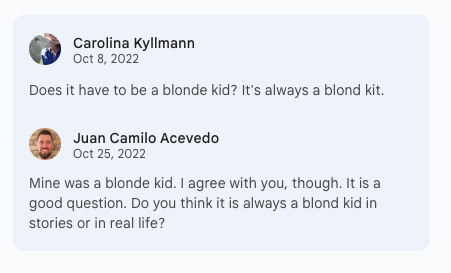
Now go back to your time in fourth grade. Those weren’t easy days. They look fine today but back then, oof! It was rough. Every problem was enormous, and every solution was entirely new and particularly complicated. Like everyone else, you hated homework. Those who were good at it liked the praise but not the homework. Homework was a chore, and chores stink. To add to your hate of homework, you found love. It came in the form of a blonde kid. You thought the blonde kid was the most beautiful in school, the coolest, and the smartest1.
Yes, this was your life back then. You had that big box of WTF called love inside yourself. You didn’t know what to do with it, what it was, or how to get rid of it. You also had a long and annoying list of tasks to do for school. All this while everyone kept telling you they wished to be in your shoes — que es de los peores dichos que hay, by the way. Fourth grade was hard.
Diligently, for that whole year, you sat at your grandfather’s desk and did your chores. You fought the distractions that your mind threw at you one by one. Sometimes, you fantasized a little before coming back to writing, and sometimes you stood up and jumped off the bed to the ground several times. Each time you would go back to writing. And as you wrote, you gently tapped the right front leg of your desk with the metal square T ruler you inherited from your grandpa. Gosh, you loved that square! It was heavy and precise. It wasn’t the transparent plastic BS the other kids at school had. This thing could break a skull if you wanted — al menos eso era lo que decía tu mamá cada vez que la llevabas al colegio: “no vayas a matar a nadie con esa escuadra!”
Tap, tap, tap.
Gently and softly. Day after day, you tapped that leg while you did your homework.
Tap, tap, tap.
While your brain hummed all the songs your grandfather could only dream of.
Tap, tap, tap.
Until the leg’s structure started to give way and splinter fiber by fiber.
You were oblivious to this. You were thinking about your blonde love and that jerk from school you knew was lying every time he spoke, yet all teachers were eager to believe. And in front of you lay the half-finished essay sobre el Descubrimiento de América that you couldn’t care less about.
Tap, tap, tap.
One whole year. The beautiful symphony of your rambling thoughts, your gentle hums, and the square hitting the wood kept playing in your room.

That was your parent screaming. The tap stopped. There’s no escaping the fact, you broke the leg. For the first time in a year, you hear the silence. It hits you like thunder right in the middle of your soul. Up to that point, you had no idea what a soul even was, but now it is crystal clear you have one and that it is a hurting bunch of nothing. You will never feel this again in your life. That mix of anger and shame and helplessness – ay 🐠🧠, qué fuerte, ¿no?
You hate the adult in front of you because that adult is pointing to the inscrutable reality of your mistake. At the same time, it is the only person that can give you some comfort. But that adult is mad at you. You can see it, feel it, hear it. Deep inside, you know that emotion is right. You would be mad too. In fact, you are mad too! So you have two angers, yours and theirs. And you don’t want theirs. You want to throw it back at them with all your might.
TAP! TAP! TAP!
You grab the square, heavy as it is, hit the broken leg harder than you ever have and throw yourself to the ground to cry because there is nothing else to do.
Sob, sob, sob.
That day, for the first time in your life, you become conscious of the complexity of your relationship with your parents. That day, when you are confronted with the intensity of that soup of emotions, you start your very human and very endless road into rationalizing.2 That’s the beginning of your journey into adulthood. It will end one day, but you have now taken the first step.
After crying intensely, after reluctantly hugging your adult, and after calming down a little, you decide to make up for it. You will fix the leg using your grandfather’s tools and knowledge, honor his name and make the adult in front of you regret all their anger and disappointment.
That’s your first-ever rationalization.
Because in life, you don’t make up for anything. Things happen, and they pass, and that is it. There is no coming back. Your grandfather will never feel the pain of the leg nor the love of the retribution. All these tit-for-tat schemes in our heads come from believing that life is linear, that for each event, there is a cause – and only one – so that you can go back until you find a greater Being and it forgives you. But that’s only true in ideal physics. Every event in your life is caused by an infinite plethora of inputs, not just one. Before an effect, there are innumerable causes, not a straight line. And exactly because of that, reparations don’t work. They appease the emotion, but they don’t repair a thing. Rationalizations are just the way our prefrontal cortex linearizes reality in order not to accept it for what it is, because accepting reality is the most difficult thing there is.
Yup, that’s your first rationalization. It also marks the start of a recurring metaphor we’ll revisit: the four legs of this table. These posts won’t come all at once, and they’ll be more personal than the rest. This is the first one. It brings us closer. But don’t get touchy-feely; we aren’t there yet. We will be, but not right now.
Leg 1: The University
Spoiler: you try to fix the leg, but it doesn’t work. You end up having to replace it. Worse, you have to ask for help from your parents, who end up doing most of the work. Your desk is still your desk, but now it has a new mismatched leg.
I arrived in the U.S. in 2008, con una maleta de ropa, unos dólares y una ilusión, como dije en el primer post. I came sponsored by a fellowship from the University of Chicago. It was a big deal for me. The number of events I remember with great detail is very limited. Weirdly, most of the memories I hold on to are moments of shame and regret,3 yet there are moments of pride and accomplishment too. They are fewer and less intense, but they are stored there somewhere. With them, there’s the memory of the day I received a call on my cell phone offering me the fellowship.
Getting a call was an occurrence for me in those days. I had a girlfriend who hated that she loved me, so she never called; my friends were broke; and my parents were probably tired of me not picking up. Calling cell phones was expensive back then and fundamentally different from calling landlines. So yeah, no calls, let alone a long-distance one telling me I was being offered a stipend and free tuition for a Ph.D. program in fucking Chicago. I remember hearing the other side’s voice telling me the offer was very competitive and that I should consider it.

Here’s the thing 🐠🧠. Let’s give this moment the epic nature it deserves. When you grow up in the middle class of the twentieth century, you are taught education is the way to a better, fuller life. It will give you the necessary tools to thrive professionally. It will allow you to improve your quality of life and self-actualize. It goes deeper than that. As Bernstein brilliantly showed: the history of the education system is the history of the middle class. I know this sounds kind of weird. Yet it is true. They are two conceptual constructs, two abstract things, two very different intellectual objects, yet they are equivalent. Lo sé 🐠🧠, lo que te permite hacer el cerebro con la realidad es una cosa loca y fascinante. The sociological proof for it is complex and incredibly long so we won’t go there, but you can read it here.
I am nice and know my job is to simplify without falsifying, so here I offer proof with the two things I am trained at, logic and cultural narratives.
Consider the premises: 1. The Poor do not have access to elite education. They stay poor. 2. The Rich have access, but do not need it. They stay rich.
The Middle Class is the complement to the union of these sets. They are defined by a specific tension: they have access, and they desperately need it.

If you crush the homework and nail the essays, you can transmute yourself. You can become rich, but with a moral bonus: you didn’t inherit it; you earned it.
This is why the university is our center of gravity. It defines everything, even by its absence. It explains our schizophrenia regarding dropouts: we condemn the poor kid who drops out of a broken system, yet we worship Zuckerberg or Gates as transcendent.
The result is a silent, terrifying implication: We have decided that being educated is more important than being good. ¡Sabes que para ser un pez gritas mucho! Ya lo sé que tú no lo piensas así pero se sigue de tus presupuestos, ¿qué le vamos a hacer?
And yes, I will have my tangent, even if it breaks the flow. Because the 20th-century academic machine didn’t just elevate the degree; it deconstructed the alternative. It turned “being good” into a cultural object with no objective value. “All is narrative, all is text, nothing is real.” To the modern academic, moral objectivity is just a religious artifact—and for them, religion is the devil.
So when I got that call, and they said I should consider it because it was a competitive offer, I didn’t know how to respond.

Can you win the lottery twice? Can you choose between jackpots? Is there more than one exit?
That was silly. That was just my ignorance. That was just me coming from the margins. In the margins, no excess money can pour into universities, accounting is tight, and everything is tit-for-tat. You don’t get more than one opportunity. You work your ass off, you pray for the best, and when you get it, you lower your head and say mil gracias and accept whatever is given. In the South, we are taught obedience.4 So that was the only response I was capable of: mil gracias, tell me how to get there! That is all I need. I would have made it work even if the stipend was half the amount.
I left my punky south to the noir north con una maleta, $2,000 y una ilusión.
Let’s go back to the beginning for a second and close the metaphor. Imagine yourself as a four-legged desk. Not a cartoon image. Instead, imagine this desk holds your soul, and it rests on four pillars.5 For me, one of the legs was education. When I accepted the scholarship, I thought that this leg had just been strengthened. I rationalized it this way: I had done my homework diligently, I had worked hard for the credentials, I knew how to think critically, I knew how to take all kinds of tests, I knew how to write essays, and I knew how and who to ask for recommendation letters. And I fooled myself, thinking it was all because I was so smart.6 For sure, I thought luck had played a big part, but also I felt like I had earned something, felt like I deserved it.
When that first winter slapped me in the face with its blunt force, the leg of that desk had already started to splinter. I just hadn’t noticed. I’ll save you the specifics, you don’t need them; stories of drinking and despair are all the same.7 I’m sharing my realizations with you because those are the ones that hurt, and that’s where the lessons are.
Oh our silly middle-class souls. You live enough time in this ethos and you start confusing things. You confuse the education system with what you think is its product. It is a self-validating story! And so far away from reality. Yes 🐠🧠, just look at the world around you. One thing is the creation and transmission of collective knowledge and the apprenticeship of the young, together with the perpetuation of old and valid cultural patterns, and the challenge of obsolete ones. One thing is the careful guidance for the development of children and the thoughtful and meticulous teaching of how to be part of the human fabric we call society.
Another thing is institutionalized indoctrination. Sounds extreme? It isn’t. One thing is loving God and being a good human according to your beliefs, and another is the Catholic church.
Institutions – both for religion and education – are necessary to bring individual beliefs together, but past the need for them, the question we really should try to answer is whether the current system perpetuates differences more than it promotes improvements.
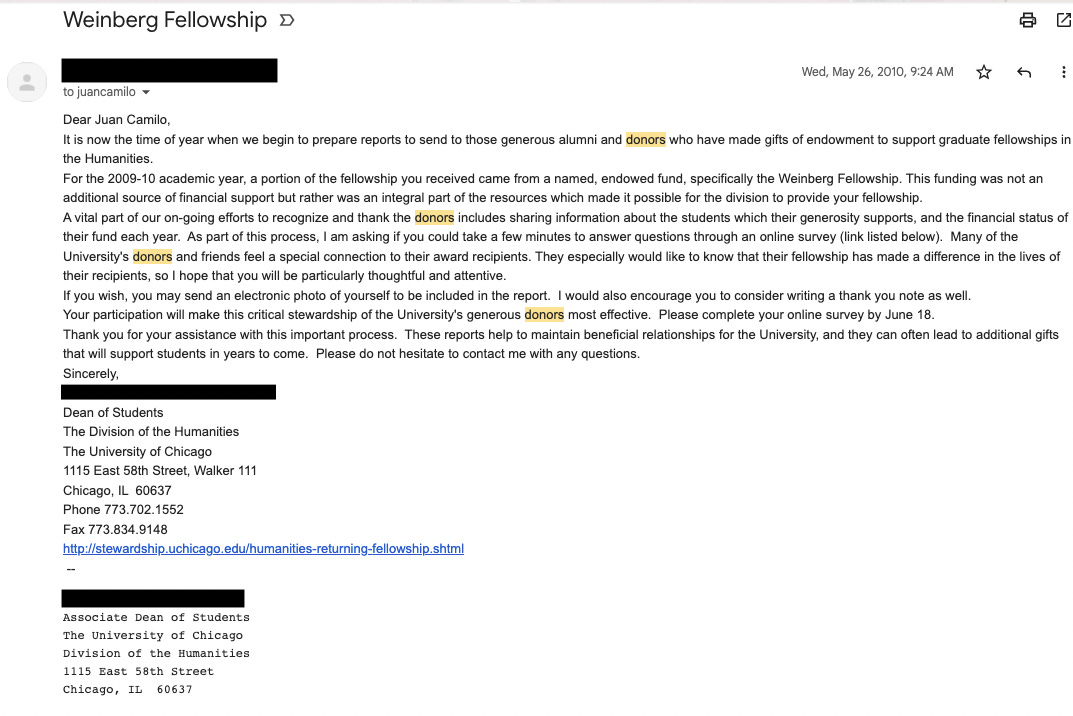
I won’t answer that today. What matters is when the crack appeared. One month after my first arrival in Chicago, I got an email8 asking me to report to the donors how I was doing in my degree. They wanted a personal and moving story. They wanted some color.9

What donors and why should they care? I have to thank rich people for what? Wut? Wait! What?!?!?!?
I thought I had earned this!10 I had/have nothing against the donors; they wanted to know what their money was doing. That was fine. I was/am all for effective altruism. I will always be grateful to whoever they were. The problem was that I fell down from the moon. I realized my ignorance. I didn’t know how the funding of the elite institutions of education in the world worked. I didn’t fully grasp, until that moment, what private education meant in the top schools in the world. My middle-class soul had just discovered elite education was a club, and that I had been invited. Sure, I wanted to believe it was because of the value of my original ideas. But it was not. I just ticked all the right boxes. And my next task was to transfer all those check marks into a nice narrative, a nice story that would invite more charitable donations.
Tap,
Tap,
Tap.
Yeah. Right there and then, I discovered I was a chicken in a chicken contest, and they gave me a blue ribbon. I had been groomed and indoctrinated, and now I had to play the part. Don’t get me wrong, though. There was no evil mastermind behind it and everybody was doing their best. There was nobody to blame other than me. Nobody was malicious or duplicitous. Nobody tricked me. I hadn’t been deceived. I just didn’t have enough information, and I didn’t have any perspective. I was just coming to terms with the way things are – este dicho en cambio es la maldita locura. Como son las cosas. Total vaguedad, precisión infinita.
Reality is brutal when you confront it, when you realize no matter how much you resist it, you will always be subdued. And as you know, I was a punky punk, and I truly hated playing the part … and clubs.
Pretty rapidly it got worse.
Let’s be cynical. Academia is indeed a medieval institution that, in many ways, hasn’t changed its mission or ways.11 All universities look alike. All universities want to emulate a handful of prestigious ones. And here’s the part our middle-class souls always want to deny:12 universities are a business, they have to sell products and services to customers. Sure, they are financed in part by the government, they might be not for profit, but they still have to deal with the main thing a business does: selling to the market. We think that turning something into a public good makes it less of a business, but that is not the case. It is like believing that our body's nutritional needs change depending on whether the food has been foraged by ourselves or given to us by our parents. It doesn't matter where the food or the funds come from, you need them to survive.
But we middle-class people turn a blind eye on the educational system. We believe universities don’t sell products, their purpose is to help us become better human beings. That’s a marketing gimmick. That is like thinking that somebody that sells you kale is selling you good health. What they are selling you is indeed a hard-to-swallow, acquired-taste vegetable. Health is the promise. The vegetable is the product. Universities sell diplomas and publications. Those are their products.
I have trained you so well, my dear 🐠🧠, and I know you are already connecting the dots. The resonances with our previous posts should already be hitting you hard. But let me give you something that, once again, might seem like a detour but it is not.
One thing you ought to know is that when the printing press comes around and universities explode, they also become brands, huge transnational brands. Take a close look at these logos

I don’t know if you agree, but these look as if they were meant to be put on a copper plate and printed on book covers. They indeed were for a very long time. Now, of course, there are plenty of new trendy ones. Nonetheless, the point stands. Books, libraries, universities, and modern businesses are all part of the same marketplace, and their construction rules were defined long ago. That’s also why most universities have carefully chosen Latin slogans. They all have a marketing strategy; their image is fundamental, their brand is everything. Because the real practical value they offer to their customers is to be able to put that brand next to their names. Academia is an authoring, authentication, and authoritative company. This is why the academic motto is Publish or Perish. In plain Colombian English: print shit or die.
Wow, that was a lot, and maybe you weren’t connecting the dots after all. Let me reframe this in a way that clicks. Here’s what I had finally understood: Academia is an economic enterprise sustained by a publishing platform. That was the kale. Modern universities operate like subsidized corporations that sell two main products: credentials and publications. That is where I was. That was the clarity that the donor email brought me.
The hard pill to swallow for me was the practical implications of that. Corporate things come with organizational charts, slogans, mission statements, lingos, acronyms, and office parties. All in themselves not terrible – except the office parties, those are just an atrocity – but then you realize it is all designed to give the product/service a uniform look and a specific way of being. If you are a part of it, you can color it any way you want as long as you don’t draw outside the lines.
As long as this stays an unaccepted and unspoken rule, no post-colonialist Derrida-lover Deleuze-and-Guattari bathroom reader will ever be able to deconstruct it. And that is the problem! Because if your mission statement is to be intellectually free, then there should be no lines. The whole system is made to incentivize and promote the people who ticked all the boxes. The hoops are so vast and there are so many of them that when you distill all the applicants, you are left with the ones who know how to obey the system and won’t draw outside the lines. The academic system is, by inception, one that excludes. It selects the people that will perpetuate it in exchange for validation from the system itself.
The people like me.
Tap,
Tap,
Tap.
Yeah, I found myself there, in the middle of the beast. I realized that access to education and making it free wouldn’t solve many of the problems. Because that doesn’t change the structure or the aim of the process: it has to be a selective system to sustain itself, otherwise what is its point? And participating in it, it is just perpetuating it.
I could have left there and then. I could have given it all the middle finger when I realized that brutal honesty didn’t matter. What mattered was to produce a certain type of knowledge within a certain type of ideology, in a very specific language, with the approval of the people in charge. The only way out was to write a corporate-looking, lingo-coded dissertation. It must satisfy the gatekeepers.
You bet your ass I tried to tell my truth, but it didn’t work. It was denied and dismissed.
So I sold my soul to the devil, just like that. It wasn’t a one-day decision. It was an endless pilgrimage of hours and hours of forcing myself to work. Continuously, laboriously, relentlessly. Tap, tap, tap. I did the best I could. I wrote a dissertation that didn’t betray or embarrass me but didn’t make me proud. Because I conceded. I used their lingo. I colored each box to its limit but no further, even though I knew the lines were wrong deep within my soul. I told myself that finishing was the only valid way to get out and say, “this shit sucks”. To leave the thing in the middle was defeat. I promised myself I’d see it through, finish, and then I could despise it all. Then, I would be above it.
But I wasn’t. I will never be. And I painfully realized that with every word I wrote. No matter the depth of my thinking, I will never be above an institution built and sustained by thousands of human lives brighter and more generous than me. My truth is still valid: the specific knowledge produced by academic thinking and categorical textual learning driven by a corporate ethos creates monsters like nazism-marxism-and-all-its-current-form-derivatives, atomic bombs, and scientific and industrialized ways to approach the human condition. Reducing life experience to a set of variables: gender, race, age, religion, ethnicity, zip code, etc., in order to gain statistical meaning is a tragedy. It explains why kids nowadays think the most important battle of their human condition relies on a third-person pronoun. It also explains why there is such an enormous mismatch between the potential we have as a species to solve fundamental problems and the problems we do end up solving. Why do we still have war? Why? Why do we still have hunger? Why? Why haven’t we found better ways to communicate? Why don’t we have a better representation system instead of one that divides everything into ones or twos?13 If we have become better at producing food and shelter, why do we have to work more and are less satisfied?
Don’t give me platitudes. I want an honest answer 🐠🧠. Think about it. It is absurd and you don’t have an answer other than “it is human nature”. That is the definition of platitude. I think we most definitely can and should solve those problems, but our incentives are wrong, and I think our education system and our views on it are part of the problem, not the solution.
The final tap, the one that broke the leg, was this: I knew the whole thing needed a change. I knew and know people who devote their lives to changing the system. I saw the importance of participating in a gigantic task like that, even if my impact would have been minuscule. Yet I chose not to. I could play it morally and say I was humbled and overwhelmed by the enormity of the task, but that would be a lie. I simply did not want to fight the way things were. I did not have any internal drive or interest in that regard, I was indifferent to the problem. I didn’t know why then, and I still don’t today. That, my fishy friend, is what I had to accept. I gave 0 fucks.
Tap,
Tap,
Tap.
After that, I had to rebuild that leg of my soul. It was simple and terribly difficult. I realized I did learn a lot, because you always can. Learning is always a choice. For me, it is the only valid choice, and so I went for it. That was how I rebuilt that leg. I separated learning from academia and the education system, and opened my mind to other ways of thinking and being in the world. I was wounded, and the leg I rebuilt was clearly not the original one. But I was freer.
They gave me a diploma, coffee mug, and a pat in the back, and I was done with the thing. I had escaped my country in the most polite way you can escape anything. I had done what I had been trained to do. I had gone through all the hoops, I had danced like a monkey dressed in a military suit. I learned the tricks and climbed the ladder, and then, when I was finished, I left the circus with ambivalent feelings and a lot of scars. And now what? That, I will tell you in the next posts. In the meantime, build a desk, learn something, or try to give the metaphoric finger to something in the same epic (?!?!) way I did.
See you soon 🐠🧠.
Meet Caro, the editor. She smarter and wiser than me. She points at the right stuff:
“The only thing worth writing about is the human heart in conflict with itself.”
― William Faulkner
“A man is the sum of his misfortunes. One day you'd think misfortune would get tired, but then time is your misfortune.”
― William Faulkner, The Sound, and the Fury
Ay mi lindo pez. Aquí voy a insertar una cosa que a ti no te va a gustar. Y es que justo por eso en el Sur somos también muy buenos pa robar y desobedecer. Por lo pronto voy a escudarme detrás de la tercera ley de Newton: si un objeto A ejerce una fuerza sobre un objeto B, entonces el objeto B debe ejercer una fuerza de igual magnitud en dirección opuesta sobre el objeto A.
Mira 🐠🧠, hay mucho más en la metáfora que lo que ves. A mi me gustaría explicártela toda. Pero no puede ser, la labor del lector es justamente la de completar la metáfora. Somos un equipo tú y yo
“The scattered tea goes with the leaves and every day a sunset dies.”
― William Faulkner
“The whiskey died away in time and was renewed and died again, but the street ran on. From that night the thousand streets ran as one street, with imperceptible corners and changes of scene ...”
― William Faulkner, Light in August
Here’s the email:
Caro strikes again:

“A dream is not a very safe thing to be near... I know; I had one once. It's like a loaded pistol with a hair trigger: if it stays alive long enough, somebody is going to be hurt. But if it's a good dream, it's worth it.”
― William Faulkner
“Civilization begins with distillation.”
― William Faulkner
There is another part often forgotten or carefully not talked about. Universities had everything to do with catholic/Christian institutions and were greatly modeled after them. The hierarchy of the University is not very far from that of the catholic church. We just don’t talk about that because in the academic ethos of the 20th century it is uncool to be religious. It’s seen as an intellectual sin, so you kind of should be an atheist.
Yeah 🐠🧠, people love to believe that a bipartisan system is SO MUCH BETTER and SO MUCH different that, let’s say, a one-party system like the one in China. That is another self-validating cute story. If you think those forced two options are much better than the other forced option, your standards are very low. Get a grip.