


Think about those shoes you love. The ones you felt kind of guilty about buying. You know you have way too many shoes, these ones are not super functional, and they were expensive. You love them though, you love shoes and this is your favorite brand. You felt judged by the whole world before buying them, even though you know nobody cares. And still, you bought them. That day in the store you thought: “debería comprar dos pares, por si acaso, pa’ cuando estos se mueran tener el otro par listo.” But then you dismissed the thought because even you have some limits.
Buying them was the right choice. Every time you use those shoes you feel like the coolest cat in the block. You walk around knowing it too. Yet the most pleasurable moment comes when somebody that knows the brand, and knows that specific model, comments on it. Somebody understands! And that feels personal: you’ve been seen.
Okay, okay, okay dear 🐠🧠, it doesn’t have to be shoes. For you maybe it’s a abag, a shirt, or maybe it’s that extravagant dinner in that super fancy restaurant that only accepts reservations if they’re done three months in advance. It’s all the same.
The mark on the shoe is doing more work than the shoe.
The point is, if somebody presented you with the same pair of shoes, shirt, bag, or dinner without any branding or context as to where it comes from - what experts call the provenance - then it’s more than likely you wouldn’t feel the same level of satisfaction or attraction towards it.
You know how and why this works, and this is true not only for the clothes you wear but also for the music you hear and the way you choose to decorate your home. It all makes you, you. Not only that, but it builds your identity, it helps you feel like you are part of something bigger.
This is tragic, you’ll soon understand why, and it is as true now as it was 700 years ago. Believe it or not – but I know you will, dear 🐠🧠 - true branding and trademarks, and the ability to sell creative expressions of the soul, were all important since bakers messed up with perfectly delicious bread in the 13th century.
And it matters, because it was this ability that immortalized an overlooked star of the 17th century Dutch painting world, someone I believe you should know more about.
Listen 🐠🧠, this is a long and convoluted post, so have patience. You will find that all links are necessary, all side-stories important, and every time I seem to wander off-topic, I’m actually only getting closer to our succulent core.
What can I say? I have lots to share. Okay, let’s talk punk rock.
Cultural Angst
The tragedy of every punk rock band is also the adolescent heartbreak of romanticism. I am talking here about the 19th-century artistic movement, not about a heart-shaped box of chocolates and a movie. Punk rockers are anti-establishment by definition1 , which in practical terms means they believe their art can get them outside the system and its rules, or at least it should.
Nothing more punk rock than taking a dump on any social convention. You can do it in a very symbolic way by, for example, playing “Anarchy in the U.K.” during Queen Elizabeth’s Silver Jubilee in front of the Parliament on a boat full of drugs, journalists, and artists. Or you can do it in a very literal way by hitting your audience with your bass2. Joe Strummer famously defined punk rock’s attitude towards its public as: “Here are our tunes, and we couldn't give a flying fuck whether you like them or not. In fact, we're gonna play them even if you fucking hate them."

Everything is fine with this ethos if you are a random band in some dirty garage and nobody listens to your records. The problem begins when you write your first hit. It doesn't matter if it is a local hit or a global one. At this point, you realize you are but a commodity of the cultural marketplace, and that’s a tragedy. Let me put it in less academic terms and in a way we can give it the right magnitude:
There is this moment
when despite you being as honest with yourself and your art as possible,
despite you not doing it for the money,
nor the fame,
nor the recognition,
you realize that you do want to land your message
somewhere,
anywhere,
you just want to be heard, seen, and understood,
—just as everybody else—
you realize that you need your audience much more than they will ever need
you3.
Sure, you can play games in your head and say: “I don’t want huge success, I don’t want a Hollywood life, I just want my art to touch some souls” — Ay joder! Y volvimos con lo del maldito soul. Ya sé, ya sé, tengo que cortarla con esa pendejada. Pronto, lo prometo. But you can’t escape it: art is nothing but a commodity. Not just any commodity, it has some special characteristics, but it’s a commodity nonetheless. In no small part, this is what drove Kurt Cobain to suicide. Art is a commercial product. In order to talk about art you need a marketplace. It all actually starts with a piece of bread, pero eso te lo explico después.
I should just get to the point but I won’t, because any day in your life you get a Borges quote is a good day, so read this one:

You have to give it to the internet. There is a Twitter account that randomly throws Borges quotes at you, that’s fantastic! The number of intellectual trips you can go on with the idea above is infinite4. It is the dream of every Foucault-lover-post-colonialist-graduate-student-with-a-gender-so-fluid-there-is-no-liquid-to-match-it. We do live in a wonderful world. In that quote, the formidable Argentinian writer chose the word commerce intentionally. Borges brings the boring Berkeleian discussion of perception versus reality and makes it a lot more interesting.
Art is produced and consumed, it is commercial by nature. In trading terms, it lives in the spread between the ask and the bid price. There can be money involved or not, but that’s irrelevant. If serendipity happens, and you are good at your job, the lighting is right, your social media is on point, your looks hit people the right way, you have a healthy dose of charisma, and there are enough punkeritos in the street ready to buy your records, then your product becomes the McDonalds of music. This happens independently of whether your art is as intellectual as a wine and cheese meeting in the English Department of Columbia University, or it is cheap and dirty like the sounds of your British lads of the late 1970s.
Realizing that all your idols are commodities of their respective mediums is not an easy pill to swallow. Por supesto que tú mi querido reader ya sabías esto. Pero no así el lector de al lado tuyo, llamémole Beto. Beto está medio perdido y además no le cree mucho a esto, mucho texto y poco contenido. For me, it was a painfully long process. It took me years to internalize it. I’ll tell you why. It is hard to come out of the 20th-century capitalism vs. communism dichotomy. Ideological wars become mindsets. In other words, they become ingrained ideas we live by without ever questioning their validity.
In this specific dichotomy, regardless of the side you pick, art is leftist by default and money and commerce are external to it, a necessary evil that we should try to avoid. This was fundamental if you were like me, a young sixteen-year-old punk rocker in the 90s in Bogotá. That was the peak of violent times, life happened in the hiatus between kidnappings, bombings, massacres, and assassinations. I know history books say the cold war was cold because it was just a tension between the juggernauts. The wise called proxy wars things like the Korean War, the Cuban Revolution, Angola, Afghanistan (the one in the 80s), the Chilean and Argentinian Dictatorships, and the fifty years of war between the U.S.S.R.-backed communist guerrillas and the U.S.-backed Colombian government, among quite a few others.
Well, if you happened to grow up in those proxy lands there was nothing cold about the tension, it was a full-on bloody massacre. Crees que me desmadré? Te equivocas. Este post tiene más leídas que el primer email de tu primer amor. The point is, when the cold war surrounds you, your whole reality gravitates around the distribution of wealth and money. Art, understood as the expression of your human soul, becomes the only escape route.
This means that understanding it as a commodity is nothing short of an abomination. Art should be the product of an unstoppable, deep creative force. There should be a damaged genius human behind it, there should be ethereal magic in its creation. Yet most certainly it isn’t.
I wasn’t the only one living in the capitalist vs. communist dichotomy, it was all of us. I know exactly when I heard a version of this idea for the first time. It was in the voice of another formidable Argentinian. A female VJ that in a random interview said: “toda la música es comercial. Quizás alguna venda más que otra, pero toda es comercial.”

It was early internet times, downloading mp3s5 was still an underground thing. It was slow and complicated, Napster wasn’t out yet. You definitely couldn’t google things, nor were there any blogs to find new music from. You were stuck with magazines, friends, and TV. Magazines and friends were expensive so all you really had was TV. I used to get most of my music information from MuchMusic, a Buenos Aires-based franchise of the Canadian-MTV-look-alike Much.
I’ll explain this for Beto and for my son if he ever reads this. MTV, Much and MuchMusic were TV channels that presented a constant flow of music videos. Between videos, VJs would give out information about the bands, sometimes news, sometimes interviews. That was it! It was radio on TV but without the ads. It was great. The VJs had the triple role of informing, curating, and critiquing music. They were the coolest people in the world. Let’s be precise: they were the coolest real people in the world. They were the ultimate consumer, they had the means and the access. Only the bands themselves were cooler, but we are switching to another dimension, they stopped being real. Consumer → real, artist/producer → magic.
That jump from real to magic that the role of the VJ points at is crucial. No traje lo de los VJs sólo pa’ remembrar, pa’ ponerse melancolico. No reader, aquí no vinimos a joder. It is what the k-pop loving teenager and the fancy academic professor have in common. They both believe in it. They might have different rulers and units of measurement, but the jump is still there. They share the belief that there is a somewhat suprahuman greatness that can be achieved, importantly, only by a few. That possibility is what gives meaning to this gritty, quotidian, day-in-day-out, wonderful thing we call life. Precisely because you believe that a product is somewhat magic, it allows you to turn the mere act of consuming a cultural good into something less mundane, less quotidian, and less passive.
You see, when you consume an artist - suena feo pero ya tú me entiendes - it is not only the art you consume, consumption in the cultural marketplace is an act of affirmation. Always. Okay, okay, okay, 🐠🧠, I am tired of the word acrobatics too. Sueno como a profesor del departamento de Sociología, y eso me perturba un poco. Let’s put it bluntly. If you buy a Gucci purse, you care as much about the purse as you care about saying you are as fancy and expensive as the purse. This is easy for you to understand because you were raised by hippies and it’s easy to judge the Gucci purse lover. But get this: art works the exact same way. Not only do you want to read, listen, or watch it, but you also want to wear it. You wear that art as a costume, you find an avatar, you belong somewhere, it identifies you. You take part in that suprahuman greatness even if only as a teammate, as a roadie. It is all the same if you dye your hair pink and spike it up, or if you read Joyce in a quiet downtown cafe.6 It is the same if you buy a t-shirt with the picture of your favorite artist or if you write an academic article on Robert Musil. The intensity of the involvement might change but not so the purpose.
That’s the piece we don’t like to talk about when we talk about art, that’s the piece we like to leave out. But we can’t, nor should we, because then we would just end up in a battle against reality, and guess what? Reality wins every single time.
Keep your ajiaco in your stomach.
There is of course a crucial difference here. Art rubs our soul in a particular way that the purse doesn’t. That is it. Ya te oí, ya te oí, claro que hay gente que ve el bolso Gucci como arte, but that’s because they see something in the craftsmanship of the thing. In other words, they see something in the object that rubs their soul in a particular way. Y sí, nos tocó meterle soul a la cosa otra vez. Es claro que estoy tapando algunos vacíos intelectuales, y algunos abismos emocionales con el maldito soul. Pero ni el formalismo ruso, ni el pragmatismo gringo, nos van ayudar a salir del rollo. Es más fácil aceptar que una noche un libro, una canción o una película, nos revolvió el estómago y no sabremos ni querremos saber nunca el por qué. Pa’ qué dañar la condición humana con ingeniería intelectual?
At this juncture, you can see why the paradoxical tragedy of the punk rock band is not exclusive to them. It actually creates a symmetrical effect on the side of the audience. In any marketplace, the dream of a devoted consumer is that of finding true meaning before anybody else and keeping it somewhat hidden. Once anything becomes too popular, once everybody is capable of sharing its uniqueness, the magic is gone. Keeping it small is how we get to be truly special. Staying just out of the mainstream is really what preserves the emotional value for us.
Yet!
If art is truly special, if it’s truly suprahuman, then it’s destined to go mainstream. What is the only possible escape route to this conundrum? How can we make it universal and popular without making it mundane? We raise the cost of admission to the club. You either increase the price of ownership like crazy, think buying a Rothko, or you increase the intellectual price of participation, such as being a true fan or a connoisseur.
Respira y cuenta, 1, 2, 3. Exhala. I hear you, we are super tangled. As usual, you are right. I am not even going to try to draw the line of thought in this post. Nah, of course I will. Here it is:
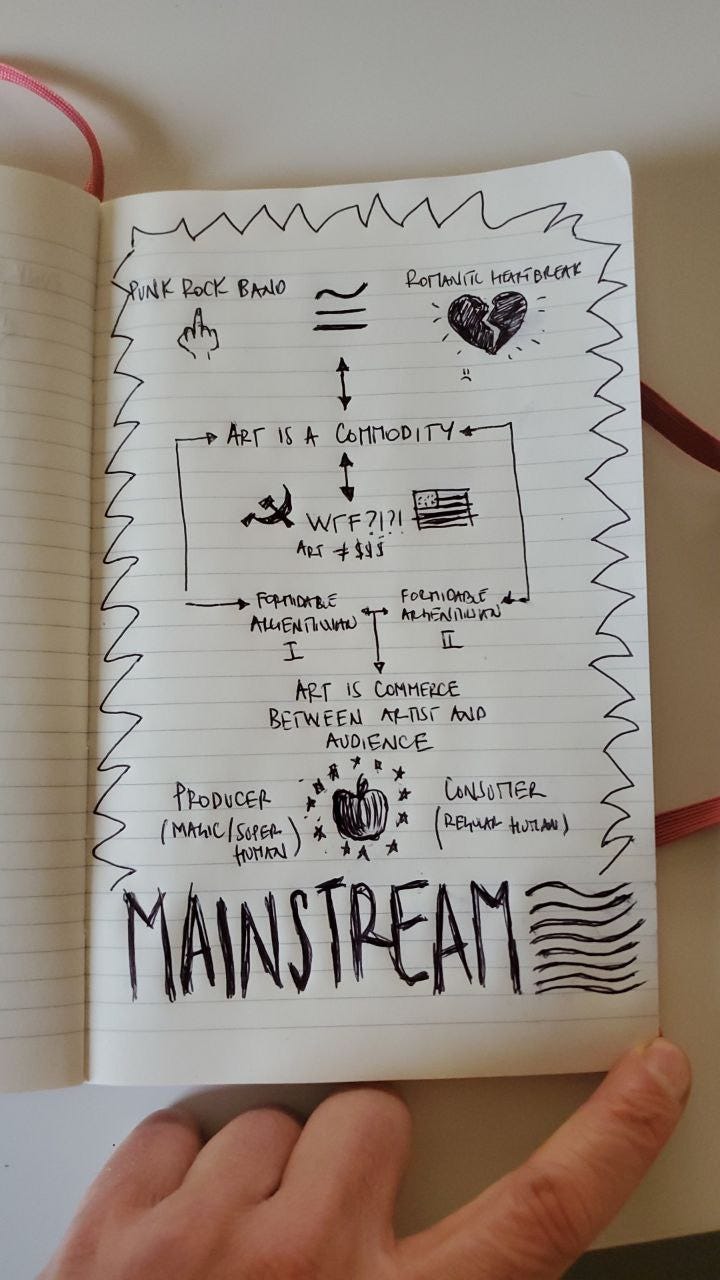
Alice will never forgive me if I don’t add any pictures here.
With this overview, go get a mate and let me just get us out of here.
Mainstream
You might remember I compared the punks to the romantics. But then again, you might not because you = 🐠🧠. I did though, and that train of thought brought us to the mainstream/art debate. Now, you read that thread linearly. I am not criticizing you, that’s how we read. But that’s not how this was written. I put the romantics’ thing there afterward just so I could come back to it.
Don’t you dare think it was gratuitous, fake, or sloppy, it wasn’t, but it wasn’t linear. That’s just how writing works. Everybody does it, the difference is that I’m nice and I show you the stitching while other writers prefer to give you the plastic feel of a smooth thread. Either way, let me tell you about the romantics.
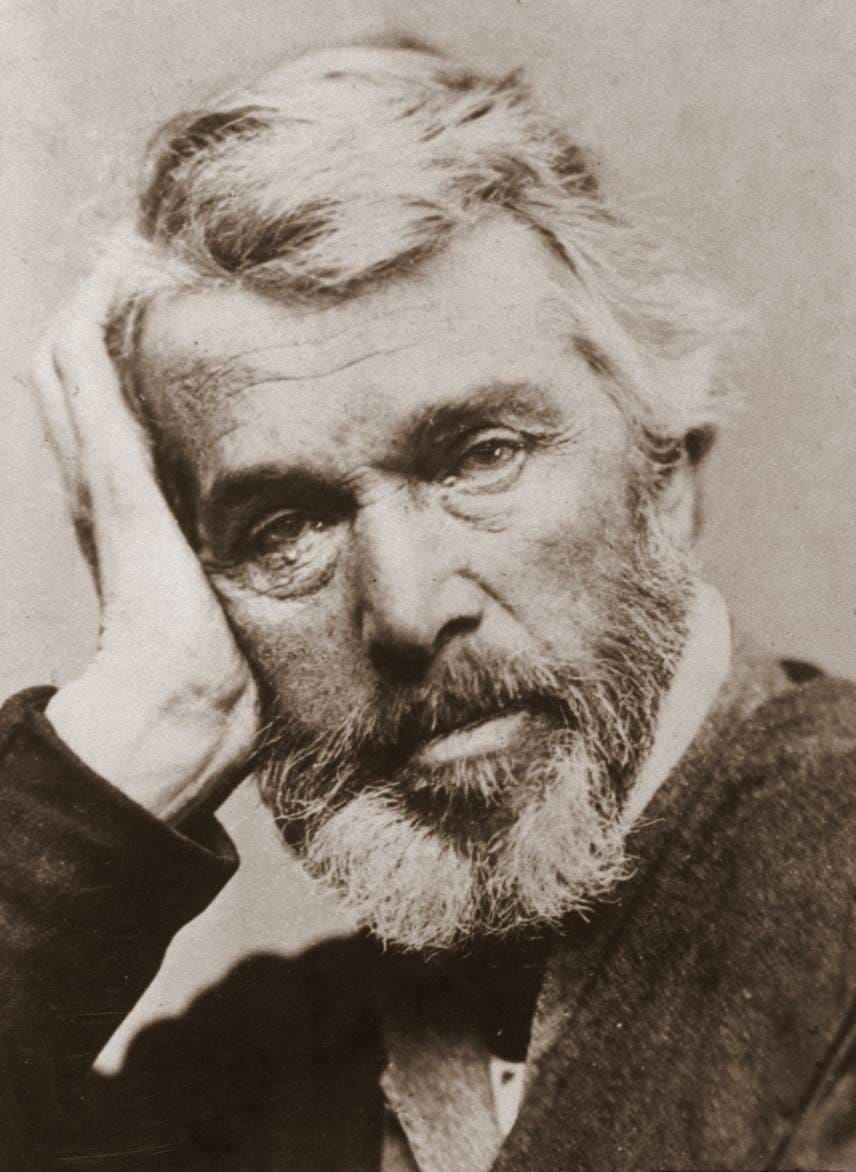
Thomas Carlyle (1795 - 1881) was a solid Scottish man — I mean this in the most physical sense of the word. He was also what we used to call a free thinker. His ideas span from history and economics to mathematics. Like a true romantic he believed in the importance of the Great Man, not exactly the übermensch, but close. He believed history was just the accumulation of the biographies of a few heroic men, so he aptly wrote the book: On Heroes, Hero-Worship, and The Heroic in History. When he said men, he meant men, as in not-women7. At first sight, it would seem like 20th-century feminism and Carlyle were exactly polar opposites in every respect. Yet their core belief is exactly the same: our social structure is mostly the product of a few old white men. For Carlyle that was the shit, for the feminists that was shit. Funny how narratives work.
The reason we are talking about Carlyle is because he popularised the term mainstream. His understanding of it is the same we use today. The mainstream is the prevalent set of ideas held and consumed by most participants of some group of streams. The hydro analogy is great. Imagine whatever you are talking about - education, art, sports, or politics - as a ginormous body of water8. This rigamarole holds all the thoughts and discourses from all the participants within a topic: everything you can say, all the memes and the gifs, your mother’s WhatsApp messages, the PDFs from your first year of college, the Facebook posts of your ex, everything about that topic or thing.
The assumption is that there is this current that holds what most people think or debate, what most people consume. It is a force that sucks everything around that topic. That is the mainstream. Yeah, it does sound like this metaphor would apply just to the internet, and that Beyonce is the magic sorcerer behind it all. It is not, it is a fully-print model, not digital. Carlyle was talking about literature not Internet hashtags. He coined the term in the 1830s. And the kids that use the term mainstream nowadays are using it in this sense too, they just don’t know it, our digital reality hasn’t changed our brains fully … not yet.
Lo interesante es que9 Carlyle, the feminists, and the punkeritos all have the mainstream in common. Carlyle wished the mainstream was filled with the ideas of his great heroic men. He wanted schools and universities to spread the words of his group of dudes. The feminists were tired that the mainstream was full of those great heroic dudes, and wanted to put their own people there. They both wanted the same thing but differed in whom they thought should be the admin. The punky punks, on the other hand, thought the whole thing was stupid and never wanted to be a part of it, and yet they were there somehow.
Another thing Carlyle, the feminists, and the punky punks had in common was that they did not fully understand the commercial nature of their thing. They were too in the middle of it. They were oblivious to the fact that the streams lived in the exchange of ideas of the consumers, in that collective chatter that it is the cultural marketplace10. They didn’t understand the rules of transmission and therefore they were either waiting for acts of heroism, subversive revolutions that would overthrow the patriarchal establishment, or hoping that their peeing on the stream would somehow put them above it. If you have peed in a swimming pool, and I know you have, you know how that plan works. Ya sé, nos pusimos gamberros, ¿y qué le vamos a hacer?
I chose Carlyle, the feminists, and the punky punks because they represent three moments in the consolidation of the cultural marketplace that I think are emblematic. I am aware this selection was arbitrary. I recognize that this is an oversimplification of a complex reality. As I said in footnote 9, that is exactly the job of all writers, to simplify without falsifying. I could have chosen differently, yes, but I didn’t and you will have to deal with it. The three moments are these:
The identification of the mainstream (Carlyle). This is crucial. When you define beautiful, you also define ugly. When you define life, you define death. When you say mainstream, you acknowledge that there is a set of ideas that all of us together consume and produce, and that there are rogue ideas outside of it. This abstract and liquid marketplace is where art, ideas, authors, your views on vaccines, or the critical analysis of the White Sox 2021 season live. The identification of the mainstream needed to happen with the romantics and not a minute earlier because the stream wasn’t big enough to be noticeable. Moreover, it is only because the stream was so big and powerful, just because our brains were so conditioned by three centuries of printed books, that we get Scottish dudes like Carlyle thinking that History can be reduced to a small set of biographies. This is why we needed the romantics.
What we consume defines us (the Femmis). You might think that I don’t have a lot of respect for feminists. You’d be wrong. You confuse my nonchalant style with disrespect. It is simpler than that, I am an aspie and therefore it’s hard to read my tone. Am I joking or am I serious? No lo sé, it’s hard for me to know too. I will say that just the fact that all the feminists are lumped into a single group is an abomination. That said, I did it to signal the moment when a group of participants of the cultural marketplace realizes that the architecture that holds it defines its contents. This is not easy to see when you are inside because you are romantic and you think the content is your personal and individual creation, or at least of whichever author you are consuming. The femis didn’t articulate it like I just did, but their struggle did show it to us. Were they the only ones? No. Could I have picked something different? Yes. Do all current postmodernists’ reclamation discourses like the LGBTQI and anti-racism folks owe their theory to the femis? Most definitely yes. There are your answers.
The realization that you can’t escape the mainstream (The Punky Punks). Go back to the days when you could actually see the establishment for what it is, when you realized it is run by somebody else and you get no choice in the matter. Imagine you are ambitious and you have some energy and integrity. You have no option but to give it all the middle finger and try to do things your way. You become your personal version of punk and dive into it hard. But as you grow old, getting shit-faced and spiking your hair becomes costlier both in terms of physical and social effort, so you evolve your ways. Because you are who you are and you have integrity, you also hold tight to that original angsty attitude. The courage you had to poop on the system because it was an unfair system, because the rules were written before you, because participation wasn’t optional, because life was an imposition, that courage doesn’t just die. Therefore, you remind yourself you’re alive and you realize that this is much better than being dead. You figure out the core of your attitude was not the pooping, it was the honesty, the soul-crushing impossibility of living against your own self. Because you can’t. You cannot but come to the conclusion that punk is about giving’em the truth and demanding nothing different than it. You make peace with the fact that the architecture of society isn’t perfect and that it wasn’t made by you and the ones like you. And you accept the fact that it can change and that it’s on you to spread that message. You either add something beautiful to the streams or you just keep peeing. You chose the former. It is scary but it is also wonderful. In the end, you realize: “without people, you are nothing”.
Take a deep breath.
Bread Crumbs
Uy, reader! This post is not like the ones before. I have already opened and closed four macro threads and dropped in at least three micro ones. On top of that, I have been playing that game where I state something and then go somewhere else, seemingly taking us through a detour that, in the end, isn’t a detour at all but the precious peanut inside the shell. It is fun but your brain is all knotted and tickled and you are thinking: pa’ dónde va este cabrón? Se van a conectar los hilos, o me hizo leer su verborrea mental pa’ nada.
Tranqui viejo, tranqui. We made it to the bread which is what you were waiting for. Imagine this: you are walking down the street and it smells like freshly baked bread. You know the smell. It takes you all the way back to your childhood, it is primal. You know it is coming from Rigoberto’s bakery. They make this delicious bread that is soft all over, doughy but not underbaked. You’ve been forging metal all morning which has made you tired and hungry. Callate reader, in this imaginary scenario you are a metal worker in England in the 13th century, but the bakers are all Spanish. Mi casa, mis reglas. You tell yourself: “keto is total bollocks, I am eating some bread.” You go in and buy a piece. When you grab it, you can feel it is still warm, warm and light. If you wanted you could squeeze it in your hand and turn it into a small dough worm, just like you did so many times when you were a small kid. But you don’t do that. Instead, you go outside. It is the middle ages, so the air is clear and pure. England has never been this sunny. You inhale a mouthful of fresh air and finally, slowly, take a small bite.
¡Rigoberto bellaco! No me han desconfiado los clérigos como a ti, ¡adobacueros! ¡pellejero! ¡Chilindroso y mandilon! ¡Barba de cabra, roncador de cojones, azafranador, rascamulas, puerco mondonguero, badajon! Maldigo el día en que te parieron, y maldigo a tu mula, a tu perro y a tus hijos.11
The bread tastes funny. It is all crumbly and nothing like you imagined. You‘ve been here before. Ramiro, the baker two streets down, used to do this all the time. They cut the flour and replaced it with sand. WITH SAND! ¡Qué malnacidos! Ramiro did it so often that they ended up taking his right to baking bread by royal decree. You are furious! Not only are you hungry, you are heartbroken, you were salivating hard for that bread. What are you going to do? I don’t know! It’s the 13th century so you can’t simply leave a super sassy bad review online or release your anger in a Twitter thread.
Well, chill out, your king has your back. Because this practice and other worse ones were so common, all through the 13th-century the English Crown issued laws regarding the production and sales of bread and ale —the most basic human needs according to the Brits. Usually, the laws would deal with the bread itself: the ingredients, the weight, the prices, and so on. They were quite precise too. The aim was to protect the customer and guarantee a very consistent experience. Unless you are a baker, these laws are pretty boring. But in 1266 a more interesting one was issued. This decree required all bread sold to be marked with the emblem of the baker. Yes, each loaf of bread needed to have a Trademark. The objective was that if a baker was cutting the flour with sand, or selling smaller loaves, or who knows what other atrocity, it could be easily identified and denounced. Bastante sofisticado si me preguntas. Sí, sí, ya sabemos, nadie me preguntó nada.
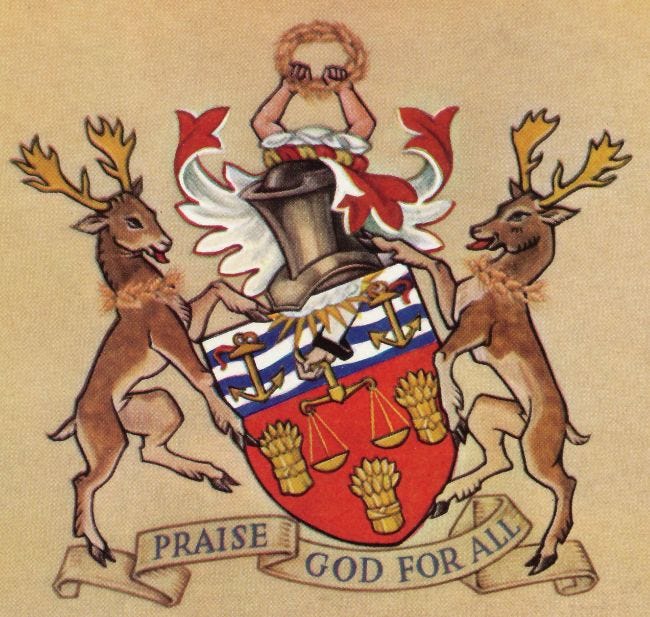
At this point, it should be clear where I am going and why this matters. But we all know you are slow sometimes my dear 🐠🧠, so let me draw it out for you: this whole bread story is important because, for the first time, you have a product - a commodity - that is required by law to always look the same and be the same so the consumer gets a consistent experience. Moreover, that consistent experience is supposed to be identifiable by a graphic emblem and a particular establishment. In other words, you just witnessed the birth of branding.
Now, it is the 13th century so Rigoberto and Ramiro can only produce so much bread, and even though they were really good, especially Rigo, you and I know that no two loaves of bread they produce will ever be exactly the same. You might think this is part of the beauty of handmade stuff. The problem was that the lack of consistency, compounded with the reduced capacity these bakers had, didn’t let them become the first true brands the way we know big brands nowadays. You can see why, can’t you? They are almost there, but not fully; one thing is a corner store with a logo, a well-established bakery is a different thing entirely.
This bread example points to something crucial: for a trademark to become the graphic representation of a consistent consumer experience - a brand - we need industrialization. In other words, we need the printing press. Yes, yes, yes, I know that in school they taught you that industrialization started with the steam engine and that it was British ingenuity that made the whole world what it is. Well …
The first product ever mass produced, the first proper assembly line, the first industrialized trade and object that you and I could both consume equally, was the printed book. Que sí reader, que sí, ahorrate la googleada, es cierto. The steam engine is a great mechanical triumph of engineering, but the true difference of industrialization is the possibility of producing the same effing product en masse. And that was the printed book. If you want to be anachronic and get all national about it, well yeah, it was the Germans! Does it really surprise you it was the Germans that invented industrialization via the book, and the English appropriated it for history? Nah, it doesn’t surprise me either.
Once again, let me derail you for a second. Imagine you live in a time where every book is unique. Books are these gorgeous objects made in a workshop by monks; not just one, several monks and apprentices make each page of each book with love and care. Each book is the only copy of itself that will ever exist. Each book comes with particular images and specific notes. Each book is a piece of art. When you own that book, you own something truly special. This is the pre-printing press world.
Then this group of animals suddenly arrives, this bourgeois scum with a filthy invention that produces books en masse! This is the dictionary definition of anathema. The images lack quality and there are few of them, each page is just a bunch of mechanical types, all looking the same, all a little boring. The quality of these printed books is not the same as the books produced by the monks. You can barely call them books. You laugh at them, you think the people producing and buying them are ignorant idiots. You might even think it is dangerous that some random Graciela Ramirez can now start producing books in her garage and you’re convinced maybe somebody should forbid this printing business thing.
But the problem is the bourgeois scum can produce around one thousand copies in the time it takes you to produce one12. As you can imagine, this lowers the cost per book a lot, and now you can have one thousand clients versus just one. As a consequence, for the first time ever, your whole town can consume the exact same object because it is cheap and identical. The price of admission has been lowered and the stage is ready for a mainstream story.
You spend a couple of years being a curmudgeon about it, blaming the kids for this barbarity, until you accept that your dreams of stopping it were dead before you even had them. The whole thing has already taken over the world and there is nothing for you to do but to embrace it. But you don’t because you are angry. Suena familiar, no? Los de la facultad de sociología dirían que los cambios tecnológicos siempre conllevan cambios epistemológicos, y que en esos cambios hay una cierta violencia. Ya tu sabe’ que yo intento como puedo salirme de ese tonito tan molesto. Yo lo veo así, cuando la tecnología te cambia la forma de interactuar con el mundo, la cosa siempre se pone peluda. Porque aprender cuesta, ta sabroso, pero cuesta, y los años mi dear reader no pasan en vano.
The thing doesn’t stop there. While you pout and say: “NFTs are crazy!” (🤪), this bourgeois scum realizes: “if we want the masses to read these things, we have to sell to the masses, not to the cultured elites.” Also, they can only sell so many bibles - which are a great product but you only need one at home. So they decide to sell the stories about people like you and me, making it through life one day at a time. Heck, they even start selling stories about criminals! And guess what? Those sell like hot bread —I know, I know. While you’re cursing these young kids with their new technologies, the whole town is discussing the crime novel in the pub. Alberto gives his interpretation, while Roberta disagrees with him. Then Rafaela decides to write an article about the crime novel, sharing what she learned from it and how it had an effect on her life.
Both the priest of your parish and you are livid. “WTF is this?” You tell the priest to write a good speech about how these atrocious books are going to ruin the youth's brains. He gets annoyed because he really doesn’t need anybody telling him what to do other than God, but he plays nice because he is the priest after all. You decide to pay a printer to print that sermon and to spread it across town as fast as you can. “A dose of their own medicine,” you think to yourself, grinning. Your wife thinks you’re silly but she plays along because life is hard and she has better things to do. The priest’s speech flies through town, not because it’s good, it’s not, but because it’s a fight! The bourgeois scum is super happy because their business is growing even more with all this controversy. They hire another writer to make a second crime novel and market it as a new version of that controversial crime story. It sells like hot bread again. You and the priest can’t even. You get after them with another printed sermon, this time longer and meaner. And so the cycle repeats. Again, and again, and again.
You should get it by now: the stream Carlyle was talking about, now you see it happening live and the point is clear. It’s only after industrialized products are created that the stream starts to form. Because in order for the stream to truly exist, it needs enough amplification power, it needs volume and, more importantly, it needs unification and consistency. We need to be talking about the same thing. The stream is a product of the printing press.
I know, how satisfying is it to come full circle?
Is your ajiaco still in your stomach? Keep it there, la cosa se va a poner mejor. The bread example isn’t only relevant because of industrialization, but also because of the mark, the trademark. You see, that small graphic symbol that identified the bread is what ties it all together.
Now that the bougies have created the stream, the trademark is fundamental. It is the literal and metaphorical materialization of what will identify your brand in the stream. The printers understood this, that’s why they all created printer marks that identified their books. They realized that, in a sea of similar-looking books, the consumer would need something to help them choose, something to trust the commodity they were buying. They also knew that what they were producing was something to be proud of, so they wanted to sign it. Just like the bread, but this time in enormous volumes of centuries-lasting products. That’s how, for the first time ever, you get true branding.
You now have all the elements: a marketplace, a reproducible commodity that can be consumed by all at the same time, and a recognizable producer that identifies its products with their name.
If you’re wondering about the importance of the books’ authors, and whether they precede the printers, let me tell you they are second. The main stars are the printers, then come the authors. Authors are, ultimately, a product of their medium; they are the ones that can bend it, produce inside it, and use it in ways that rub your soul, but they don’t make the medium, they are not the architects. The printers set out the rules and the authors follow.
You might think: “Well Juan, do you know this guy Socrates? Wasn’t he an author?” Too smart, but not smart enough. Although we consume Socrates the same we consume Shakespeare or Sylvia Plath, although we throw them all in the same bucket and we consider them authors, what they produced was very different. Their crafts were very different. Socrates’ product was ideas. Ideas that in his time were transmitted orally using written language as a musical score. Socrates was not a writer of books, he was a nomadic TedTalk presenter to put in terms you will understand.
Shakespeare produced plays. His product was double, the shows and the printed scripts. But the printed scripts weren’t for the masses, they were for the theater companies, those were the clients. His craft was closer to that of the young Hollywood script writer wannabe than to that of Doris Lessing let’s say. In any case, just like Socrates, Shakespeare wasn’t a writer of books. That’s not what he did.
On the other hand, Plath was an author of books, full on. For Plath the marketplace was fully defined and the product was printed books. Sure, she had to fight through the ranks to get access to the presses, but the structures of the print world were in place and the platform was fully developed. So,

Yet, the way we consume Socrates and Shakespare is the same way we consume Plath, as if their products were printed books. So we think of them as authors just like Plath. We project our current understanding of what an author is into the past.
The thing is that our kids will do this again, but this time with the internet and onto the printing press. That is hard to understand I know, but the following will help you.
Choose your favorite writer from the twentieth century. Mine is Mihail Bulgakov. The kids of the next century will analyze him not as an author of printed books, but as an influencer, a digital-author. Sure, they will not call it that. But the Bulgakov they will be getting is not the one you and I got, the printed commodity. They are getting a digital thing, a digital commodity, and they will analyze him under those rules. Just like we never really consumed the real Socrates or his real product, we got a printed version of him. This does not imply Bulgakov was an influencer. He was not. But the one my son and yours will be consuming will be. Did printers make the rules? Yes. Did I make my point? I did. Whether you agree or not is a different story and it’s also irrelevant, but now it should be clear what I mean.
North★
Cornelis Hofstede de Groot belongs to that set of people that have some place in the digitized history of the world but of whom we know pretty much nothing about. In other words, he has a Wikipedia page, but nothing more to tell us anything about his personality. Did he brush his teeth twice or once a day? Did he prefer coffee or tea? Did he love football or did he think it was a thing for the plebs? We will never know. He is considered the first true — as in academically achieved — Dutch art historian and systematized an impressive catalog of the Dutch painters of the Golden Age (seventeenth century). That’s it, kind of.
He seemed to have been an intransigent and rigid man. When he attributed a painting to an artist, that was it, he wouldn’t change his view. In printing press times that would not be a problem, but the internet doesn’t follow the same rules. The net is unforgiving and it will make sure to store all your mistakes and have them ready for anyone to access wherever at the speed of a click. Well, here’s de Groot’s world-famous fiasco.
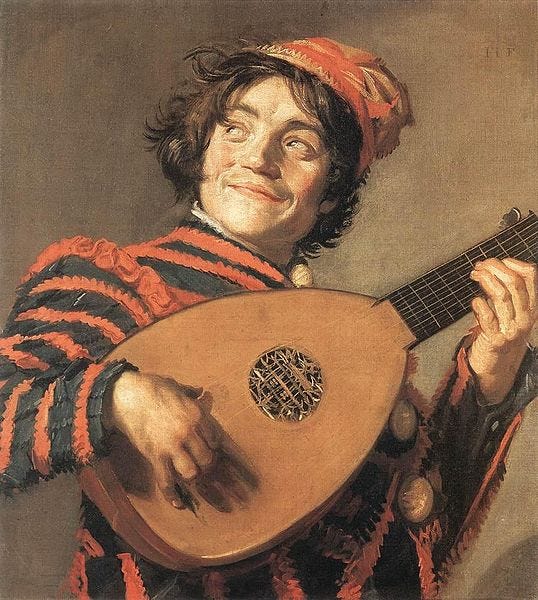
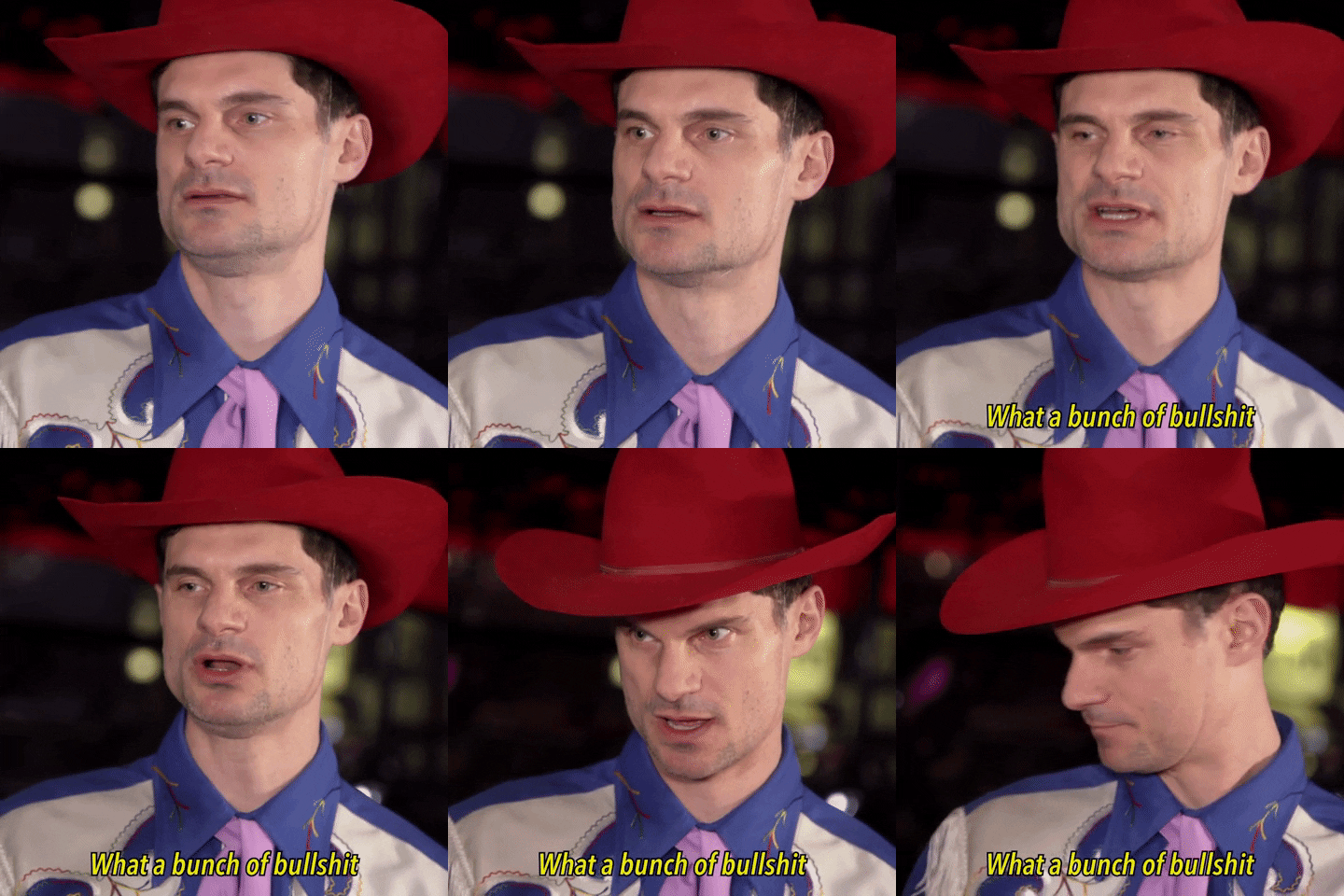
In 1923, the Dutch historian attributed a portrait titled “A laughing Cavalier” to Frans Hals. Hals was a Dutch painter from the seventeenth century whose works had gained a lot of popularity during the 1800s. You know, Rembrandt was all the rage for a long, long time. And there was Velasquez and all the other Golden Age peeps. But the public gets tired of consuming the same thing. Sometimes we just need something fresh, something similar to what we have but a notch more obscure and unknown. When you find something like that, oof! I mean, it’s like you just increased the density of the mainstream, you just made it a little bit better. Hals played that role in the 1800s, especially thanks to this beauty:
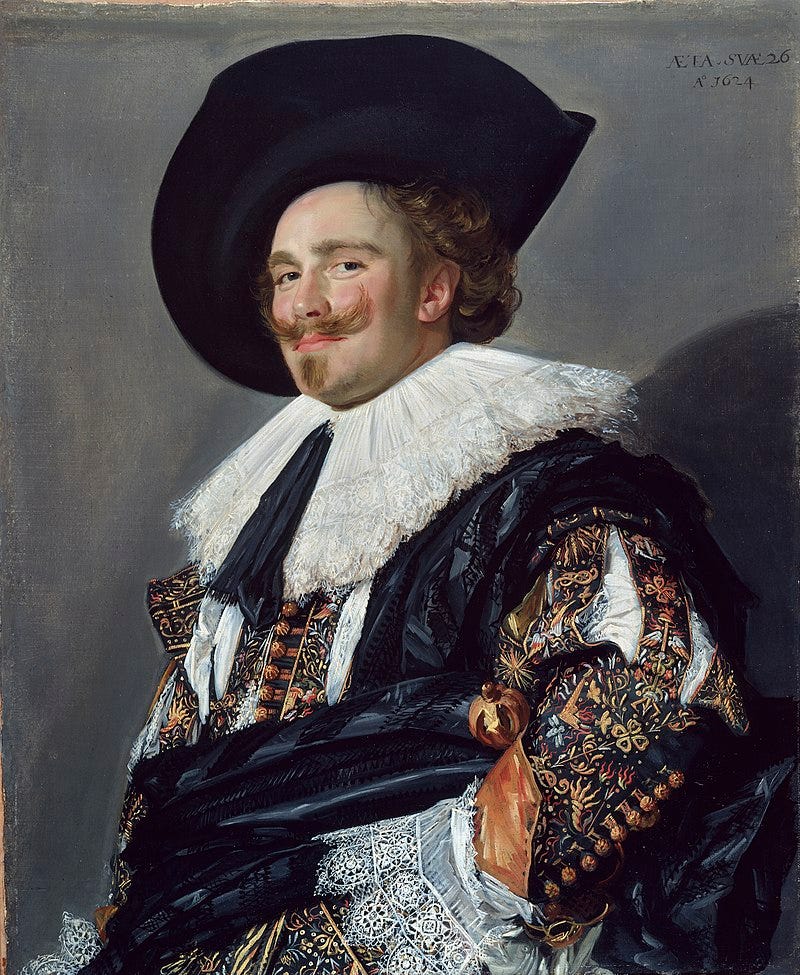
Painted in 1624, this gorgeous portrait became really famous in England in the 1800s. You can see why just by looking at it. Have you seen a better mustache? I haven’t. At the time of writing, this portrait is the main attraction of the Wallace Collection in London —do check this video. Like the immense majority of paintings of the Golden Age, this one didn’t have a title.
Titles are, ultimately, indexing tools of the printing press. In the 1600s we were not fully there yet and titles were not needed. However, 200 years on we land in full-on romantic times, so we think in terms of books and libraries; things need to be indexed and categorized in bibliographical cards. Paintings need titles. The English public of the 1800s gave this painting the title “The Laughing Cavalier”. This was such a successful example of spontaneous branding that it even became the logo of a beer13.
In the early 1900s one of the most ambitious and productive art forgers of all times, Henricus Antonius van Meegeren, smelled an opportunity and created a second “Laughing Cavalier'' and falsely signed it as Hals. You have to give some credit to the Dutch, their names and their staches are on point. Van Meegeren’s commercial sense was tremendous: creating another Frans Hals was one thing, but a second Laughing Cavalier was way smarter. This second painting was the one that de Groot certified as Hals’ in 1923. Well, as I just told you, It wasn’t.

When the truth came about Muller & Co, who had bought the painting based on de Groot’s certification, sued the seller. The Dutch art historian would rather die than take the fall. He bought the painting to avoid both the scandal and the lawsuit, and defended its authenticity until the day he died. Wikipedia doesn’t care though, the forgery was proven and van Meegeren has a much bigger role in the mainstream than de Groot ever will. ¯\_(ツ)_/¯
Keeping up with the rhetorical leitmotiv of this post, we now have to go backward. I am going to show you a symmetrical example of what I just described but, this time, it works in favor of de Groot. As you can guess, this might feel like a detour but it is not, it will be the peanut’s core. Hang on to your staches, we are about to kick it.
It was 1911, Louis Béroud waxed his mustache and headed to the Louvre. His intention was to go to the gallery where the Mona Lisa was hung and paint the scene. In those days, that painting was just another Da Vinci. Certainly, it was gaining popularity, but it wasn’t the most well-known painting in the world. It wasn’t the mainstream. Also, in those days, galleries at the Louvre weren’t packed with tourists so all kinds of artists would go there to copy the works of the masters. It was the most productive way of learning.
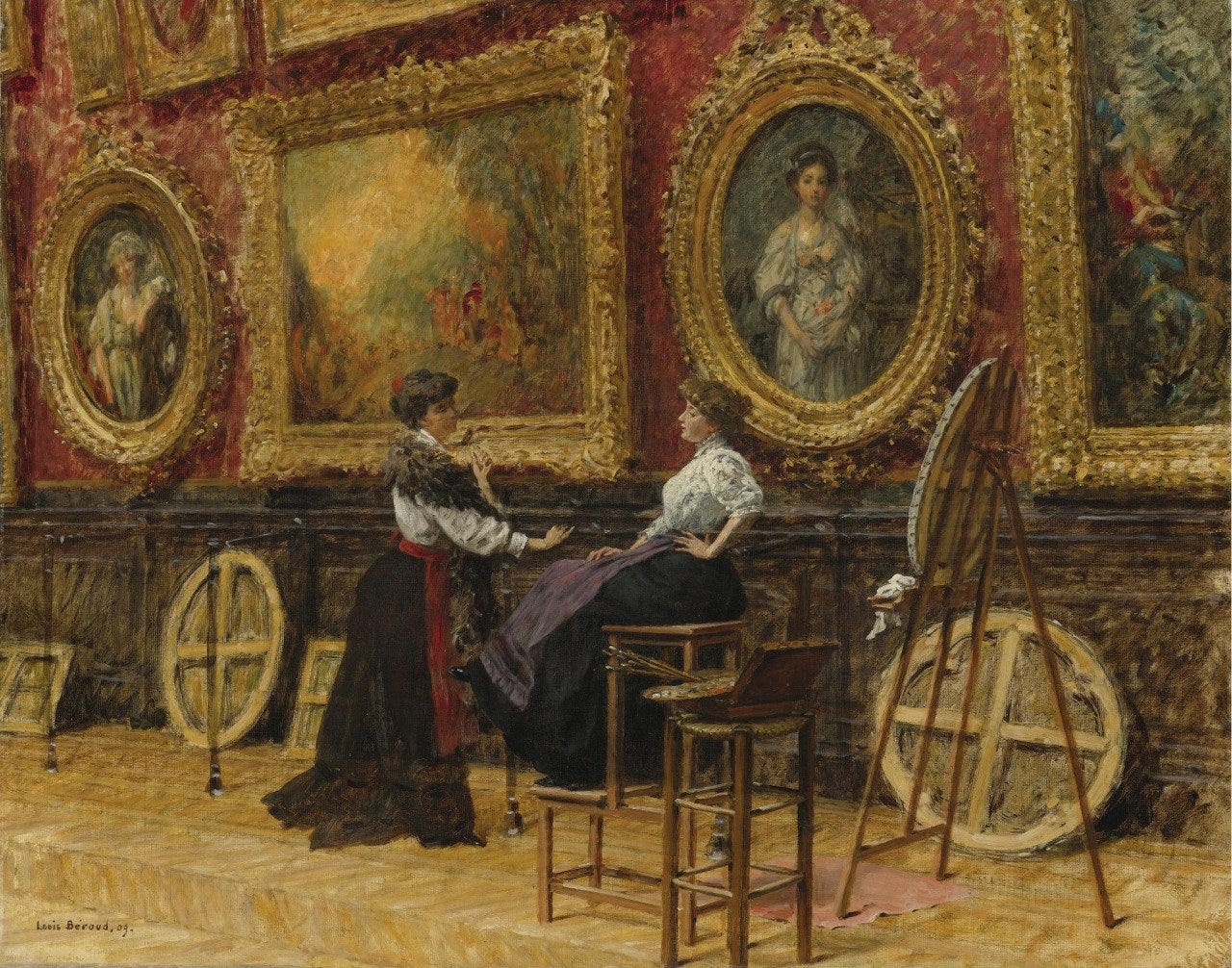
When Béroud arrived at the Italian Renaissance gallery he did not find the Mona Lisa. He asked the guards about it. They didn’t know where it was. This should have raised a flag, but it didn’t. They assured him it must have been taken to be photographed for marketing purposes. Béroud came for what he came for, so he sat and waited. A few hours later the head of that section of the museum showed up. Béroud inquired about the painting again. He didn’t know anything about it. This finally raised a flag. The head of the section checked with the photographers just to find out they didn’t have it, nor were they scheduled to photograph it. The painting was missing.
Oh f*ck!
Yup, it had been stolen and nobody had even noticed until Béroud asked. This naturally became an international news story. It was an enormous media event, it made it right to the center of the Mainstream. That’s why the Mona Lisa became the most famous painting in the world. Because it was stolen.
Sure, not any stolen painting would have made it. You needed a good base to start with, but what puts the Mona Lisa in the center of the Mainstream is nothing more than a crime story. As you know now, crime stories sell like hot bread. And hot bread is exactly where art comes from. Fortunately for the world and for Béroud, the Mona Lisa was later found and returned and Louis could finally make the painting he had intended to. Here’s a nice podcast on the story. And here’s the painting:
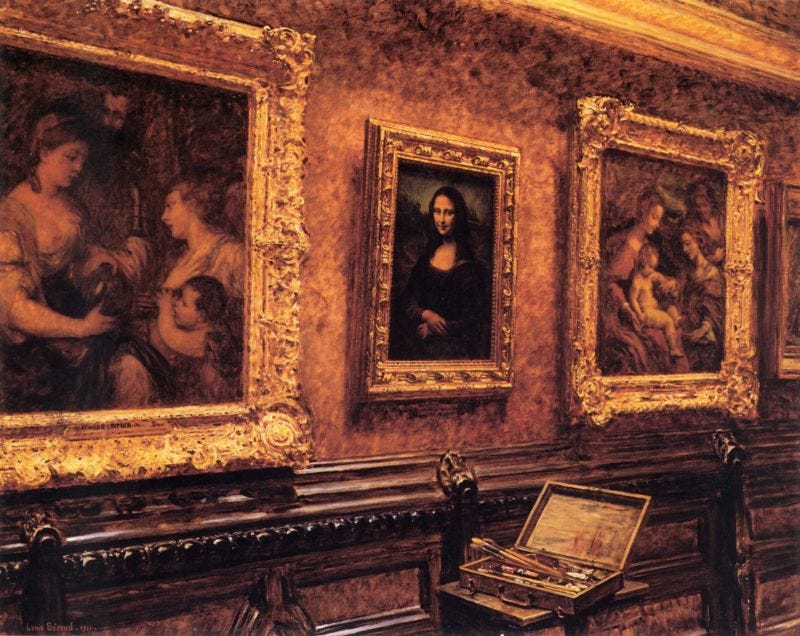
Several of Béroud’s paintings are just repetitions of copyists in different galleries of the Louvre. Others are just the galleries and the public. But a particular collection does make it into the works of Béroud routinely: the paintings and the collections of Baron Basile de Schlichting. The Baron had amassed an amazing collection including all kinds of authors, from the Italian and French Renaissance to the Dutch and Spanish Golden Age. Béroud painted Schlichting’s home office, his living room, and then the gallery bearing his name at the Louvre. As you can guess, Béroud was a little obsessed with the Baron’s collection because it contained all that was considered hot stuff at the time. It was a significant piece of the Mainstream for sure. This included, of course, a Frans Hals. The dutch painter had gained popularity in the late 1800s thanks to his awesome cavalier, but also because all the impressionists were copying him.
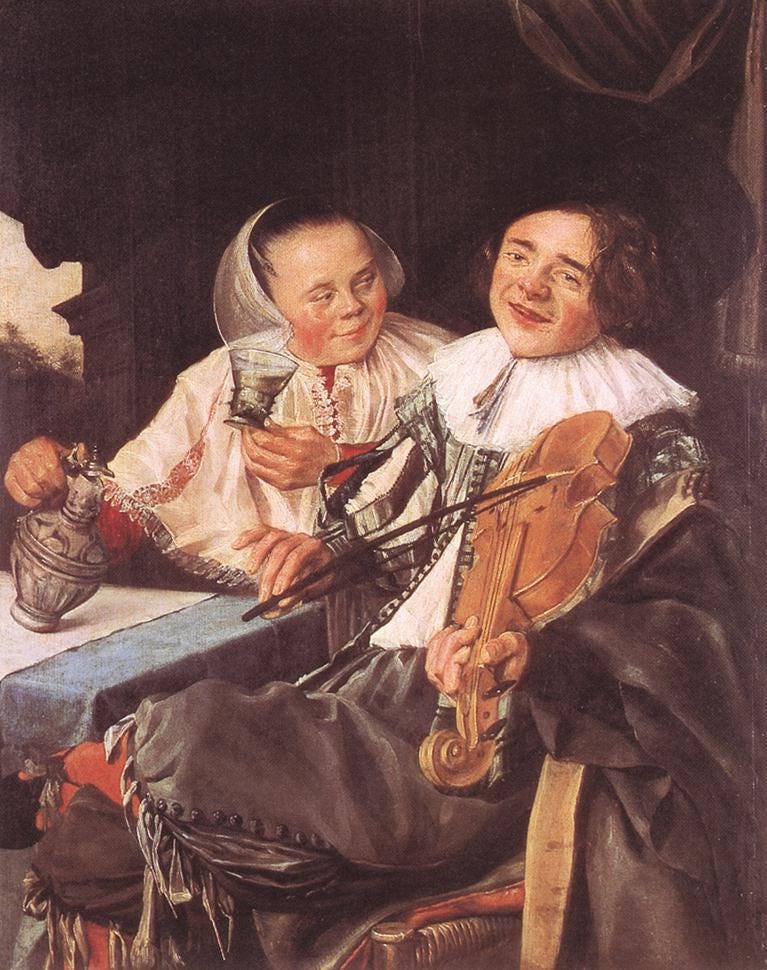
Next to the Frans Hals, the Baron’s collection included another very interesting piece: The Carousing Couple. All throughout the nineteenth century this painting had been sold attributed to Hals. In 1892, right at the peak of his popularity, the art dealership Lawrie & Co decided to buy the piece from another dealership for 4,500 sterling. During the process, they found something funny: Hals’ signature was off. This wasn’t a Hals! They immediately sued the seller. It is not clear what happened or how things went down because the lawsuit was unusual and everything was settled outside of court. What we do know is that Lawrie & Co hired de Groot to give his opinion about the authenticity of the piece. Our rigid and strict first Dutch Art Historian discovered something amazing. Under Hals’ monogram, which was proven to be fake, there was a nice monogram containing a J and a star. The date was 1630.

De Groot researched the monogram and found seven more paintings misattributed to Hals all bearing the J★. He quickly realized the author was Judith Leyster, who was quite a successful painter in her time but was completely forgotten in the 1700s and 1800s. He then did what every son of the printing press and of the nineteenth century would have done: he cataloged her works and published a paper on her. In other words, he created a bibliographical record of each of Leyster’s works, giving them titles, dates, and a provenance. This my gorgeous 🐠🧠 is exactly what a librarian would have done. You think that is natural, and it is for you because your brain is made out of 3x4s. But make no mistake, there is nothing natural about it. Regardless, and this is the interesting part, it’s in this precise moment a star was born — or reborn.
We know crime stories sell like hot bread and de Groot had one. He proved that most of Judith’s works had been historically attributed to Hals or to her husband. He proved she was an artist in her own right and that, in her time, she was highly regarded by the public and other artists. He proved that white dudes like him, writing the history of the Arts, had just stolen fame and authorship from Leyster. Just like the Mona Lisa needed her theft to become a huge success, Leyster needed a crime to regain fame. Just like the Mona Lisa, this wouldn’t have happened if Leyster hadn’t actually produced something of value, but you know, the world is full of artists of value and just a tiny percentage of them make it to the mainstream. Because to make it to the mainstream you need a story, a trademark, and a brand. Leyster had it all.
The Puzzle
You should be able to see all the parts now. I’ve laid it all out there. I could leave and I’m pretty sure you would finish the work. But that’s mean. I bet your brain feels heavy and you kind of see how it all ties together but also you don’t. I am nice 🐠🧠, let me do this for you.
Judith Leyster was the daughter of merchants, of bougie scum. Her parents’ first business was in the textile industry, which sounds very fancy. They were not fancy, I mean, kind of fancy, but not really. As I said, bougie scum, or in the lingo of a 90’s sociology student, they were pequeñoburgueses. Her father was proud of his trade and his talent and called himself a Laystar, a guiding star. That was his brand.
But after years in the textile industry, things came to an end. They needed to move to something more lucrative. Los bougies siempre echando pa’ arriba. Siempre con un poco de culpa cristiana, pero siempre pa’ arriba. So they bought the brewery “The Two Crows with the Cross.” They also bought the house next to it, moved in, and immediately changed their name to Laystar. By their name, I mean they changed all the names: their family name, the brewery’s name, and the house’s name. They hung a big sign in the front of both buildings and started signing everything as Laystar14. True rebranding; they were business people through and through.
Judith studied painting in her adolescence, most likely under the guidance of Frans Pietersz de Grebber. There are indications that she might have been Frans Hals’ apprentice, but they are faint15. What we know for sure is that her application for a membership to the Guild of St. Luke was approved in 1633. The guild was an association of painters, sculptors, engravers, and … 🥁 … printers. They basically had control over the whole marketplace in Leiden. Being approved as a master of the guild was not a small thing, she was only one of two women registered as painters. The process to get in wasn’t easy either. You needed to work under a master for four years and show that after three years of study you were selling your art to the public. That means that part of the test was to make your art commercial and prove you could sell. Then you could present a painting as your final exam. Once accepted you could call yourself a master of the guild. Leyster went through all the hoops. We believe this self-portrait was her masterpiece.
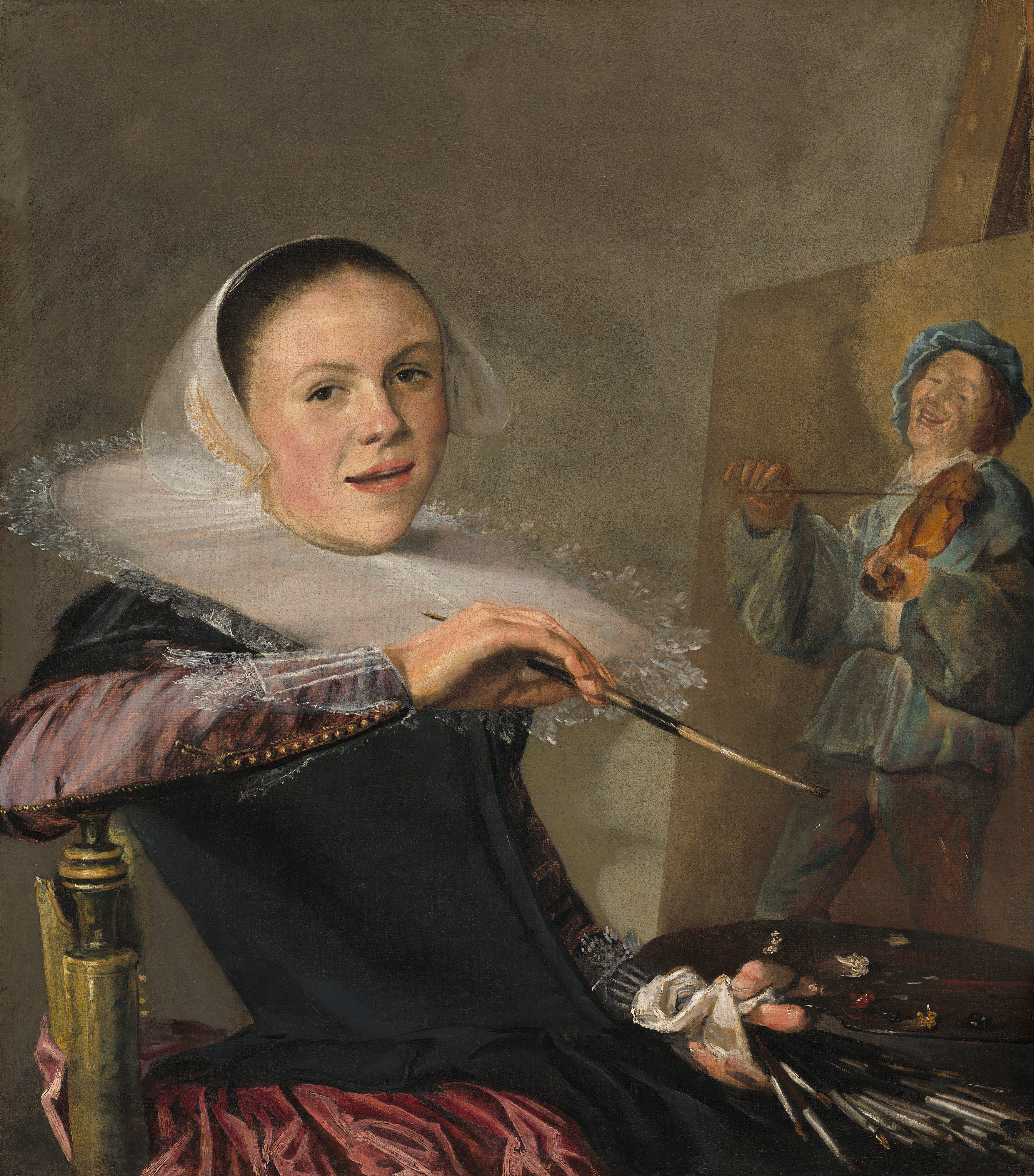
After she was accepted in the Guild as a master, Leyster lived off her art until she got married to Jan Miense Molenaer, also a painter. It seems that once married, she stopped painting and she devoted her life to running her husband’s studio and to managing the family properties. In total, we have 16 of her paintings16. Of these, 11 have the J★ that allowed de Groot to identify her works. Most of them are scene paintings, in other words, she depicted ordinary people doing ordinary things. It makes sense, her clients were other bougie scum that wanted to embellish their houses with her paintings. Her style was that of her contemporaries, and she produced some truly remarkable pieces.
Now, here’s where we tie it all up. Stop thinking of Leyster as de Groot wanted you for a second. Stop thinking of her as the femis of the 20th century would want you to think of her. She was not a silenced voice of the patriarchy, she was a businesswoman. She had a trade. Her colleagues, the artists, engravers, sculptors, and printers of the Guild, were all bougie scum. They were selling entertainment and decorations.
You see, in that period of time, the art that held real value and differentiated the rich from the poor was jewels. Remember the colonization of the Americas? They went for pepper and spices but found precious metals, chocolate, tomatoes, corn, and avocados instead. That’s the definition of good luck to me. Despite the massive new influx, precious metals kept being the luxury of the rich. However, the gold and silver from America17 flooded the European markets with liquidity. That, in turn, created a market for other fancy objects, entertainment, and luxury items. There was money to spend! That’s where the paintings, sculptures, fancy decorations, clothes, and all other things from the Masters of the Guild came in.
They were commodities, consumption objects that the bougie scum were ready to produce and wear. That’s why the guild grouped painters and sculptors, but also printers, woodworkers, textile workers, and so on. These paintings weren’t the product of the romantic geniuses we then got used to - hopeless expressions of the human soul - they were the product of very smart salespeople. Tranquilo, tranquilo, tranquilo, I know that hippy parents’ upbringing is messing with your head again. If you believe I’m implying they were all doing it for the money and were soulless people, I am not and they were not; they were humanists and also merchants. They were both.
One of the members of the guild who shared membership with Leyster was Christophe Plantin. No worries, I am not going to go deep into him, that’s your homework. What you should know is that he was the most influential publisher of books of the time. Nobody came close. He produced and sold books all across Europe. Just like Leyster’s paintings, his books were meant to be gorgeous objects. They were more than just accurate and precise text containers; even if you could not read the book, you could tell it was the work of true craftsmanship. Naturally, all his books had his printer’s mark, the compass with the inscription: Labore et Constantia. In plain Colombian English: Hard Work and Consistency. The leg of the compass that has the needle represents consistency and the rotating leg hard work.
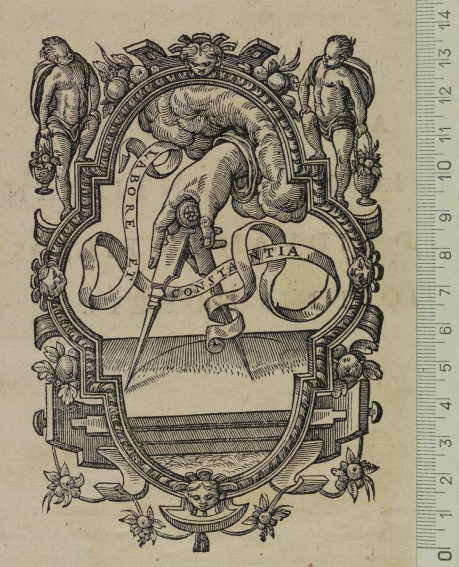
Of course, Plantin was also bougie scum, and so were his descendants. Twenty years after he died, they commissioned Rubens to make a portrait of him. If you have at least three neurons left, you will guess that this portrait shows him with the compass. I’m guessing you didn’t and putting this one together blew that third neuron. Perdón. With the two neurons that are still working, I bet you all my money you already knew he also had aptly named his house “The Golden Compass”. No? Okay, only one left. Oof, I am being a jerk today.

You love emojis, don’t you? Let me put it in emojis so that we don’t burn that last neuron, 🥇🧭 =J★.
Yup, Plantin and Leyster were doing the same things. They all were! They were all branding; with every product they put out into the world there was their personal brand, an affirmation of who they were, and what they were selling. It was what the guild master did, it was what the rules of the guild made them do. There is one important detail though, Plantin and the other printers had one advantage that nobody else had: the amplification power of their presses. That, and that they were first. For the first time, their message could reach masses. They held the architecture of the cultural marketplace. They were the gatekeepers. And the press had such a huge powerful gravitational force that the rules of the printed text ended up ruling all other marketplaces, they ended up eating all other marketplaces. That’s why centuries later de Groot had to turn Leyster into a bibliographical thing with some paintings attached to it.
The printers forged and expanded the rules, and art and everything else became pretty much a printed commodity. The mainstream and all the other streams were designed here by these guys.
So what about the punky punks? Ah, yes. Well, at this point you can see their unavoidable destiny. What did you think would happen if you had a nice melodic piece of music, a defined aesthetic, a crime story, and a nice-looking logo? You get a brand that sells like hot bread, even if your crime story is that you were robbed of your future and the whole thing is bs.
If you are able to see the beauty of a printer’s mark, you will also realize that this beauty resides in the need for a commercial medium, the need for your message to reach people. It is only in the constant consumption and production of ideas that the graphic object gains some “universal” meaning. And it doesn’t matter if it is elegant and precise like Plantin’s, shitty yet effective like the ones from the punky punks, or a nice subtle hint like the one from Leyster.
The romantics, the femis, and the punkys thought the beauty resided in the object, they confused the medium with the content, because they were too immersed in it, they were deep into the stream. But you and I 🐠🧠 we have the digital world scrambling our brains and we can see more, we have an advantage just like the printers of books did. We know that beauty doesn’t necessarily reside in an object, but in its cultural context, its capacity to reach others, and the universal need for an understanding of it. What we will never know, even though we think we do, is how the future streams will look, and how they will shape our brains. But that’s a topic for another post.
Leyster didn't sign her paintings to be remembered. She signed them because she was already there.
I mean, the punk rocker in me really wants to say: old school punk rockers, not the new ones, which is funny and you will see why shortly.
Yeah, you got a poem you didn’t ask for. Poetry is difficult reader, so if it hurts your eyes, make sure to read it as if it weren’t and you will be fine.
Yes you smarty pants reader, you are right, I am missing an opportunity here. But fuck it, a reader of your worth can read La Biblioteca de Babel, combine that with some AI and Quantum computing, and realize the old blind Argentinian was a visionary and trip intellectually there forever. I am done with that though, it leads nowhere.
Oh reader, it is funny, some versions of you will totally know what mp3s were. The majority of your iterations will not. I am nice, so here’s a link for your enjoyment.
Of course, I am not saying anything new here. At this juncture of this newsletter, you know everything was scripted. I created nothing. In this specific case, somebody said it better with this succulent and succinct phrase: taste classifies, and it classifies the classifier.
More specifically he meant white men. He was also a proponent of bringing slavery back to the West Indies. Ya te voy a decir por qué estamos hablando de Carlyle. Dame un segundo. Y también tranquilízate, si esperas que sólo hablemos de humanos de los siglos pasados que se conforman a tus sistemas de valores y a tus posiciones políticas no podríamos hablar de nadie. Por supuesto que al traer a Carlyle acá no pretendo en ningún momento defender sus atroces ideas, calma, respira, y dame un poco de generosidad .
I am actively avoiding any fancy terms here. Don’t get upset or mistrusty. I know my critical theory, I could have used Habermas, Hauser, Foucault, or any other theorist of the last century. And yet I don’t because this post doesn’t need it. We tend to make things complex at the textual level to sound smart, to create discourse, to sell books. But that’s not the job of a writer, of any kind of writer. Our job is to bring clarity, to simplify the complexity of reality. And by simplification, I mean accepting the fact that we are falsifying reality and doing it to the best of our abilities in the most productive way to our readers. Respect your reader, even if he/she/they is a
Gringos ruined the word interesting. Now it just means that you don’t want to say what you really think about the topic being discussed. I like the literal sense, that it interests you, that you want to know more, that something is cool. That’s why it’s there in Spanish. De nada.
Let me clarify what I mean. Here’s a plaza de mercado.
You see? There are sellers, buyers, intermediaries, tourists, hustlers, experts, analysts, observers, administrators, policy makers, policy enforcers, taxi drivers, animals, and a camera. Now imagine that instead of fruits and veggies what people sold and consumed were ideas and art. The medium that holds the ideas and arts might change, but the plaza stays the same. That is what I mean by the cultural marketplace, the plaza.
I cannot help you here dear reader. These are all fantastic insults from the Spanish Golden Age. You can translate them of course, yet you will not get them. It would be like believing that a Napoletan Domino’s pizza is the same as eating a pizza in Napoli. It is not. You have one option though, learn Spanish. I know you can.
I know my printing press, my numbers are accurate, fact check me.
Yes, never forget that trademarks, branding, and art as we know it starts with bread and beer. It makes total sense that a brewery would appropriate that fabulous mustache to promote its product. Have to love it when a thing comes back to its origin.
If you are noting that Judith went by Leyster and not Layster I congratulate you for your attention to detail. It is not a typo. Judith did it for herself, we don’t really know why. Maybe a way to stay connected to the family trade but having it her own way?
A little bit of cheating here from this internaut. I had to go to the print world to find this info. The internet will catch up one day. Everything will be digitized. In the meantime, you can find it here.
I am following Cynthia Kortenhorst-Von Bogendorf Ruprath’s catalog.
No matter what the gringos want to tell you, at that moment in time there was but one America and it was the whole thing, north, central and south. Here’s my proof:
![New Inventions of Modern Times [Nova Reperta], Title Plate, Jan Collaert I (Netherlandish, Antwerp ca. 1530–1581 Antwerp), Engraving](https://substackcdn.com/image/fetch/$s_!hRYK!,f_auto,q_auto:good,fl_progressive:steep/https%3A%2F%2Fbucketeer-e05bbc84-baa3-437e-9518-adb32be77984.s3.amazonaws.com%2Fpublic%2Fimages%2Faf17a2eb-7f9f-46b9-b314-0537bf845e6e_1200x927.jpeg "New Inventions of Modern Times [Nova Reperta], Title Plate, Jan Collaert I (Netherlandish, Antwerp ca. 1530–1581 Antwerp), Engraving")
That is the Nova Reperta by Jan Collert. It was a book of engravings published in 1600 that contained the 10 modern inventions most valued by its author. As you can see, one of the inventions was America. I am being silly, it was the first one, the most important. This book was published in Antwerp where Leyster was living at the time. The printer was Cristopher Plantin, of whom you will hear about in a second. Interestingly enough, even though the letters and the map clearly say America, the commentator of the Met Museum that describes this page on this webpage, thinks that this is a map of America — as in the U.S. — and Africa. I am not here to shame anybody, but … I mean ... Scratch that, I am here to shame that fucking idiot.